Author Archives: Greg Peters

Research Sheds Light on Nocturnal Habits of Lesser Prairie-Chickens

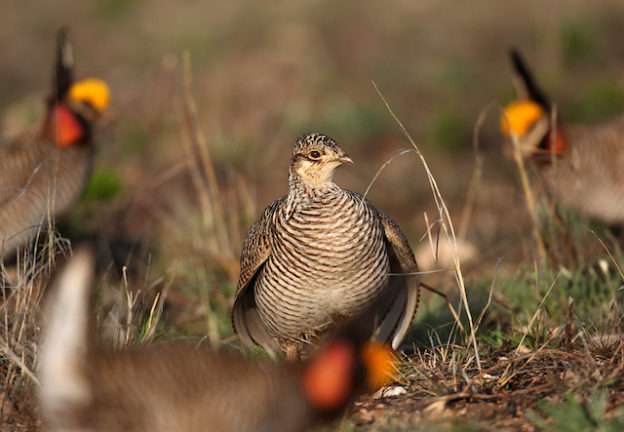
What do lesser prairie-chickens do at night? Until recently, scientists had very little data on the bird’s after-hours behavior and habitat preferences. Researchers from Oklahoma State University are filling in some of the blanks, with results that can help inform conservation practices. Graduate student Ashley Tanner, a Ph.D. candidate at OSU, summarized the research teams findings.

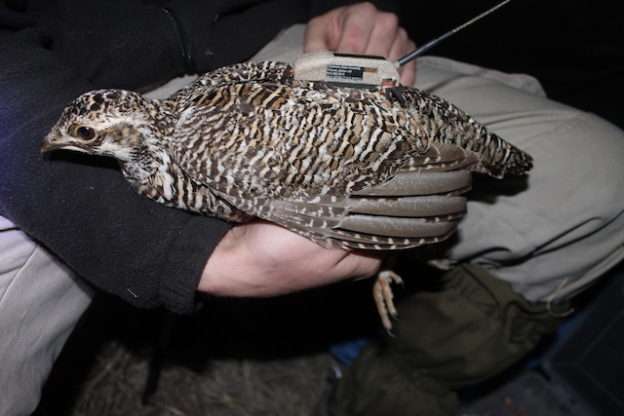
Female lesser prairie-chicken with satellite transmitter. Photo Dwayne Elmore, OSU

“Despite the fact that lesser prairie-chickens spend nearly half their time budget every day, throughout the year, at nocturnal roosting sites, we know relatively little about this behavior and associated habitat,” Tanner wrote in her research summary.

At night, Tanner noted,  lesser prairie-chickens are under significantly different pressures than during the day. For example, some potential predators are more active at night, such as coyotes, bobcats, great-horned owls, and American badgers. These additional pressures may alter habitat selection from what is typically used during the day.

Tanner’s research team analyzed 31,324 nocturnal roost locations from 103  individual lesser prairie-chickens (71 males and 32 females) in Beaver County, Oklahoma. They found that mortality was no more likely at night than during the day.

Female lesser prairie-chicken with satellite transmitter (photo Dwayne Elmore, OSU)Moreover, the team found that once a lesser prairie-chicken selected a roosting site, movement from that site was rare. They noted that lesser prairie-chickens moved at least 50m only about 6% of the nights, and moved more than 50m less than 3% of nights. Given the low rates of nocturnal movement, any disturbance that causes a chicken to move nocturnally would be especially disruptive to these birds.

Additionally, the team found that course-scale habitat use during the night was not significantly different than habitat used during the day. Lesser prairie-chickens use areas with higher amounts of plant biomass for roosting.

Tanner notes that the research results fill a substantial void in knowledge about lesser prairie-chicken ecology, helping managers make appropriate conservation management decisions that account for the bird’s needs throughout the day.

Texas Field Trip Showcases Lesser Prairie-Chicken Conservation

Thanks to LPCI partner organization, the Western Association of Fish and Wildlife Agencies (WAFWA), for this story.

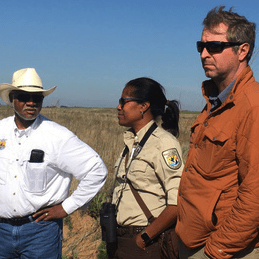
A Texas Panhandle meeting and field trip organized this spring for regional field staff of the U.S. Fish and Wildlife Service (FWS) highlighted efforts on public and private land to conserve the lesser prairie-chicken.

FWS officials met with WAFWA staff and representatives of the Lesser Prairie-Chicken Initiative Council in Lubbock on April 17. The following day, the group toured the Yoakum Dunes Wildlife Management Area with Texas Parks and Wildlife Department staff to observe on-the-ground conservation efforts on state land, and also toured a nearby private ranch that is under a term conservation agreement with WAFWA.

The group was treated to the inspiring sight of booming lesser prairie-chickens on two leks, saw plenty of other wildlife and they were all encouraged by what they saw.

“One word sums up the day: awesome!” said Benjamin Tuggle, regional director for the USFWS Southwest Region.  “I am sure that through our continued collaboration and communications we will strengthen our partnership and foster additional opportunities for conservation in the Great Plains.”

WAFWA Story Map

The landscape-scale conservation work currently underway for lesser prairie-chickens in five western states is massive in scale and complex in scope. To help people understand what it’s all about, WAFWA has recently launched new “story maps” to explain different elements of the plan and how it all comes together. The interactive site is easy to navigate and provides detail in easy to understand terms.

View WAFWA’s lesser prairie-chicken story map.

Putting Conservation Easements to Work for Ranchers and Wildlife

When ranchers in the southern Great Plains take part in conservation assistance through the Natural Resources Conservation Service-led Lesser Prairie-Chicken Initiative (LPCI), that assistance most often takes the form of time-limited conservation agreements, such as the Environmental Quality Incentives Program (EQIP). These 3-5 year contracts have proven tremendously valuable in restoring habitat for lesser prairie-chickens and other grassland-dependent wildlife.

They have their limitations though. In a best-case scenario, a landowner finds that the conservation practices they put in place through the short-term conservation agreement greatly benefit his or her ranch operation and bottom line, so that when the contract ends they continue the wildlife-friendly practices. But in reality, once the contract expires, economic issues or myriad other factors can prompt a significant change in land use.

Conservation easements are another voluntary practice in LPCI’s conservation toolbox that can provide long-term benefit to both landowners and wildlife. What is a conservation easement?
It’s a voluntary legal agreement between a landowner and a qualified organization, like a land trust, which places some long-term restrictions on the use of a property in order to protect its natural values and maintain it as a working land.

Subdivisions fragment habitat and working ranchlands.

According to Lisa McCauley, NRCS easement specialist in Montana, ranching easements usually focus on limiting subdivision development. The purchase price of the easement is based on the appraised value of the development rights being sold.  Landowners also have the option to donate a portion of the value of their easement and receive significant tax benefits. (Read the full interview with McCauley on the Sage Grouse Initiative website.)

Conservation easements are a commonly used tool for ranchers in Montana. “This year, we’re going to end up with close to 40 applications for enrollment in the NRCS Agricultural Conservation Easement Program [ACEP]—the most ever from our state,” McCauley said.

McCauley attributes Montana’s success in helping landowners conserve the range through conservation easements to the land trusts who hold almost all of the easements NRCS invests in.

“These local partners are dedicated to putting conservation on the ground, and their hard work has paid off. NRCS is so lucky to be able to partner with Montana’s land trusts, and would not be successful without them,” McCauley said.

These easements have direct benefits for greater sage grouse, the focal species for the NRCS-led Sage Grouse Initiative (SGI). Like LPCI, SGI is a partnership-based, science-driven effort that is part of Working Lands For Wildlife, which is led by USDA’s Natural Resources Conservation Service.

Through SGI, NRCS has invested nearly $42 million since 2010 to place conservation easements on 191,200 acres of sage grouse habitat in Montana alone.

Though conservation easements are much less a part of the ranching culture in the southern Great Plains, they have every bit as much potential to benefit ranchers and wildlife as in sage grouse country.

A conservation easement ensures that this 29,718-acre working ranch in western Kansas will retain intact prairie habitat, benefitting both rancher and wildlife. Photo courtesy Jim Pitman, WAFWA.

In addition to the NRCS ACEP program, ranchers in the lesser prairie-chicken’s five-state range can pursue a conservation easement through the Western Association of Fish and Wildlife Agencies (WAFWA). During the past year, three parcels of ranchland in lesser prairie-chicken habitat, totaling 33,053 acres, have been permanently protected through WAFWA’s Perpetual Conservation Agreement program.

Jim Pitman, WAFWA’s Conservation Delivery Director, stresses that the terms in a conservation easement are negotiable and the land trusts can tailor the language to align with the landowner’s desires. “Conservation easements do not restrict a landowner’s ability to control access, make management decisions, or recreate on their property,” Pitman said. Instead, they help ensure that the conservation values of a working ranch—like wildlife habitat, native vegetation, scenic views—will be maintained in perpetuity.”

How to Learn More

Ranchers in the southern Great Plains interested in learning more about conservation easements through either NRCS or WAFWA should contact their .

Thursday, May 18, at 12:00pm Central Time, the Texas Wildlife Association will host a free webinar, “,” presented by Ken Cearley – Stewardship Director for the Texas Agricultural Land Trust.


Launched in 2010, the Lesser Prairie-Chicken Initiative is a partnership-based, science-driven effort that is part of Working Lands For Wildlife, which is led by USDA’s Natural Resources Conservation Service.


Wildlife Journal Spotlights Lesser Prairie-Chicken Conservation

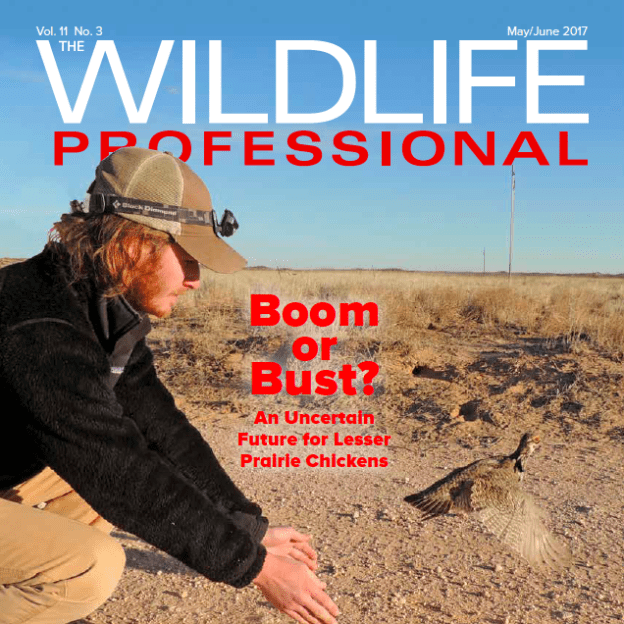
Lesser prairie-chickens take top billing in the latest issue of The Wildlife Professional, trade journal of The Wildlife Society, an international scientific and educational association dedicated to excellence in wildlife stewardship. The cover story explores the current state of lesser prairie-chickens over their five-state range.

In David Frey’s article, Boom or Bust?, researchers from across the southern Great Plains weighed in on the bird’s recovery. Christian Hagen, science advisor for the Lesser Prairie Chicken Initiative (LPCI), expressed cautious optimism about populations trends. “On the whole, things are actually looking quite good,” Hagen said. “It’s certainly not the growth rate we’d like to see, but all the trends we see are headed in the right direction.”

The researchers agree that it all comes down to habitat. “The biggest thing for these birds is intact pieces of prairie, and keeping ranchers ranching to retain prairie as prairie,” Hagen said.

LPCI partner organizations across the southern Great Plains have been working toward that goal. New Mexico wildlife biologist Tish McDaniel of the Center of Excellence described her organization’s strategy. “We put a lot of effort into habitat restoration, working with ranchers, mitigating with oil and gas. All the work that we do to try to make things as good as they can be, so when the bird numbers do increase, we will still have habitat for them.”

Lesser prairie-chickens inhabit four distinct ecoregions within the southern Great Plains—each with its own recovery challenges. Though their entire range is drought-prone, the western portion of the range receives the least annual rainfall.

Range conservationist and wildlife biologist Tish McDaniel (right) serves as project manager for the Center of Excellence, and LPCI partner that works with ranchers and the energy industry to protect lesser prairie-chicken habitat.

Colorado’s prairie-chicken population is the smallest of the five states, with less than 100 birds in the southwest corner of the state.  “In the past decade we’ve seen a pretty dramatic decline,” said Cody Strong, an LPCI wildlife biologist in Colorado. “The chicken has not done as well here [as in other parts of the range], but we’re getting its habitat in a better place now.”

Prairie chicken numbers are strongest in Kansas. Curiously, their numbers have increased significantly in northwest Kansas as the birds have actually spread into areas previously unoccupied by lesser prairie-chickens. Kansas State University researcher Dave Haukos noted that this increase appears connected with the availability of Conservation Reserve Program grasslands in this region.

Haukos struck an optimistic note about the lesser prairie-chicken’s future. “They’re a boom-and-bust species,” he said. “They’re very resilient. So long as they do have available habitat in sufficient quantity and quality, they can survive.”

Indeed, prairie-chicken numbers have rebounded across the chicken’s five-state range since the intensive drought of 2012-13, with last year’s population estimate just over 25,000 birds.

LPCI Science Advisor Christian Hagen (right) talks with Kansas rancher Ed Koger during a prescribed burn at the Hashknife Ranch.

Researchers expressed concern that climate change will push the limits of that resilience. “This is the southern extreme of the population,” McDaniel said, “And with the temperature increasing, this will be the part of the population that will be affected the most.”

For a habitat-conservation initiative like the Natural Resources Conservation Service-led LPCI, the take-away from Frey’s article is that we’re on the right track. Healthy, resilient habitat is the key to the lesser prairie-chicken’s survival. With 95% of the bird’s habitat in private ownership, helping ranchers adopt habitat conservation practices that work well for both bird and herd is an essential strategy for lesser prairie-chicken recovery.

New LPCI Field Staffer Helps Landowners Help the Land in Colorado

The Lesser Prairie-Chicken Initiative connects rural landowners with technical and financial assistance to identify and carry out conservation practices that benefit prairie-chickens while maintaining ranch sustainability. The success of our efforts hinges on our field staff members, who work one-on-one with landowners. Meet our newest field staffer, Marina Osier.


“We can have good habitat and good rangeland production—they go hand in hand.” That’s the bottom line for Marina Osier, wildlife biologist with the Lesser Prairie-Chicken Initiative’s Strategic Watershed Action Team (SWAT).

Osier is the newest member of LPCI ‘s field staff team, based in Lamar, Colorado, on the western edge of the lesser prairie-chicken’s range. Like her teammates in other parts of the lesser prairie-chicken’s range, she’s an essential part of LPCI’s mission to conserve and increase lesser prairie-chicken populations by promoting the health of grazing lands and supporting the long-term sustainability of agricultural operations.

With some 95% of all of lesser prairie-chicken habitat in private hands, the future of this uncommon prairie grouse depends on careful stewardship by private landowners. Fortunately, Osier notes, the conservation practices that benefit prairie-chickens also benefit the rural agricultural producers—ranchers and farmers—who own much of that private land.

“People want to help the lesser prairie-chicken and other wildlife,” she says. “They just don’t want to be locked into something they don’t want to do long-term.” Osier works with interested landowners to explore the range of voluntary conservation assistance available to them and identify programs that will work best for their particular situation.

Part of her work, Osier says, is to clear up misconceptions about the assistance programs. “Some people think we’re going to put chickens on their land and make them take the cows off.”

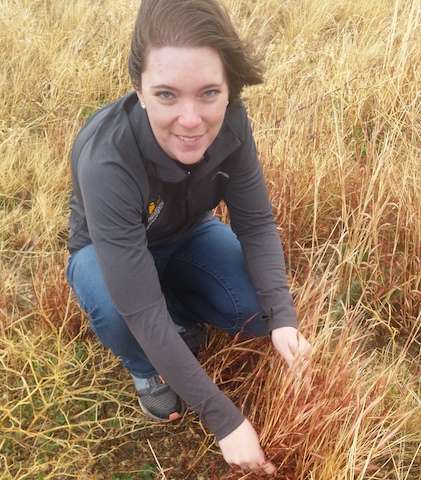
LPCI field staffer assesses vegetation during conservation planning process.

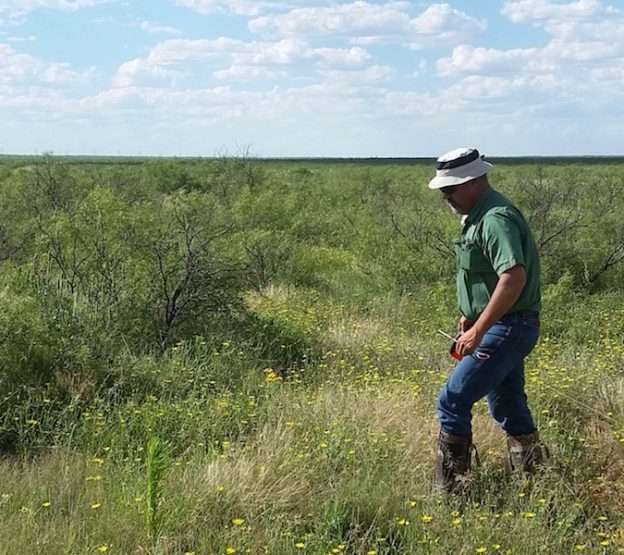
When a landowner opts to take part in an LPCI technical and financial assistance program and their land meets the criteria for participation, one of the first things Osier does is to assess the diversity, abundance, and health of the ranch’s grassland habitat.

She uses this information to create a conservation plan tailored to the rancher’s goals—one that maximizes benefits to both prairie-chicken and livestock. The plan identifies management practices—like prescribed grazing, woody invasives removal, drought contingency planning, and water system improvements—that help build the health and resiliency of the land. LPCI financial assistance helps ranchers carry out those often-costly management practices.

“I love working with landowners, hearing their stories, and hearing the history they have with the land,” says Osier. “My aim is to find common ground, through actions that preserve their way of life while preserving habitat.”

Osier’s interest in prairie wildlife has its roots in the Iowa soil of her childhood. “My dad was very interested in wildlife, and we’d talk about the birds, trees, and animals,” Osier says.

After graduating from Iowa State University with a forestry degree, she got a summer job looking at habitat for greater prairie-chickens. “I hadn’t heard of prairie-chickens before that job!”

Not long after Osier completed her master’s degree in Georgia, the LPCI SWAT position opened in Lamar, shifting Osier’s focus to the lesser prairie-chicken. In her new role, Osier aims to build connection and conversation with area landowners. “I want to talk with them about chickens—why they’re worth conserving, and how the range improvements that help chickens help their ranch’s productivity.”

Great to have you on the LPCI team, Marina!

New Mexico Range Managers Put Science to Work for Prairie-Chickens

Science-based conservation that benefits wildlife and landowners—that’s what the Lesser Prairie-Chicken Initiative (LPCI) is all about. Over the past few years, LPCI—a partnership led by the USDA Natural Resources Conservation Service—has helped fund research projects across the southern Great Plains, aimed at better understanding lesser prairie-chicken ecology in order to fine-tune conservation practices.

For wildlife biologist Randy Howard, a new mapping tool developed by lesser prairie-chicken researchers is an essential part of his efforts to restore habitat for grassland-dependent wildlife.

Wildlife biologist Randy Howard adjusts the float system on a wildlife tank at the Bureau of Land Management’s Sand Ranch in New Mexico.

Howard oversees habitat management at the Bureau of Land Management’s Sand Ranch, a 58,600-acre parcel of land 35 miles east of Roswell, New Mexico. Designated as an Area of Critical Environmental Concern, Sand Ranch is specifically managed as habitat for the lesser prairie-chicken.

Howard’s toolbox of conservation practices got major boost with the advent of a digital mapping tool that shows with unprecedented detail the extent and density of woody encroachment on prairie habitat in the southern Great Plains. In New Mexico, most woody encroachment comes from a single species—honey mesquite.

“That mapping layer has been awesome for our planning purposes,” Howard said. “Whenever we’re looking at mesquite treatment, we’re using that layer,” In digital mapping, data is organized in “layers” of information, with each layer relating to a particular land feature.

The effectiveness of the new mapping layer is compounded by another ground-breaking study by a research team under the direction of Dr. Scott Carleton of New Mexico State University. The study is the first to quantify the effects of mesquite on lesser prairie-chicken habitat use. Researchers found that lesser prairie-chickens strongly prefer sites with less than 1% mesquite canopy cover and rarely use sites with more than 15% canopy cover.

Results from that study suggest that removing mesquite in low-density (<15% canopy cover) is essential to maintaining or expanding existing habitat and reducing the threat of habitat loss.

When mesquite moves into prairie grasslands, lesser prairie-chickens move out. Photo: Charles Dixon.

Both Carleton’s research and the mapping tool development were funded in part by the Lesser Prairie-Chicken Initiative (LPCI). According to LPCI Science Advisor Christian Hagen, the targeted habitat restoration work underway in New Mexico is a great example of “actionable science.”

“This is the interface of research and management, where conservationists identify, fund, and implement habitat restoration in areas that will have the greatest biological effect for prairie-chickens and other prairie-obligate species,” said Hagen.

Howard noted the tangible impacts of this scientific research on his habitat restoration efforts.  “This mapping layer, along with Carlton’s research, shifted our thinking to prioritizing treatment of low-density mesquite,” said Howard.

This past year, Howard used the mapping tool to select three leks on Sand Ranch for mesquite treatment. “With the mapping layer, you can really see which leks need immediate attention and where you still have time [to do treatment at a later date].”

Leks are critical habitat sites, where male lesser prairie-chickens gather each spring to perform mating displays, spar with other males, and mate with females. Nesting often occurs within a short distance of the lek site.

Howard’s crew treated all mesquite within a ½-mile-wide perimeter around the three leks. Because the mesquite was low-density, the crew was able to hand-spray it using backpack sprayers.

The next, essential step in restoring that habitat for prairie-chickens will be to remove the dead mesquite carcasses, but that can’t be done for three years, since it takes that long for the mesquite plant’s extensive root system to die.

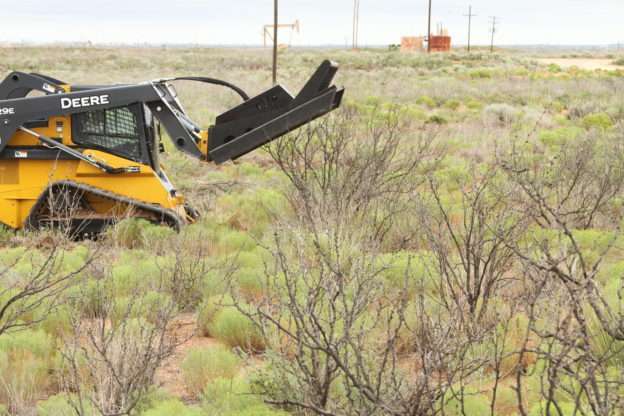
A tree masticator chews up dead mesquite skeletons, eliminating their vertical structure, which repels lesser prairie-chickens.

In the meantime, Howard will be complete treatment of three other sites at Sand Ranch that were hand-sprayed three years ago. They’ll bring in tree masticators to grind up the mesquite carcasses, using funding from the non-profit Center of Excellence, which supports habitat conservation projects for two species of concern in New Mexico—the lesser prairie-chicken and the dunes sagebrush lizard.

Howard recently received a $677,000 grant from the Center of Excellence, which he will use to treat 10 priority lek sites across eastern New Mexico. The mapping layer figured prominently in the process of selecting the leks. Biologists from LPCI, US Fish and Wildlife Service, New Mexico Game and Fish, Natural Resources Conservation Service, Center of Excellence, and BLM examined the mapping data and made their recommendations.

In addition to helping range managers identify priority mesquite treatment areas, the mapping layer helps in linking core habitat areas. “Using that mapping layer, we’re able to look at the big picture of habitat management, and we can see where we can connect lek sites with one another,” Howard said.

For example, he said, with the three lek sites they just treated on Sand Ranch, the southernmost lek is separated from the other leks by just ten miles. But because there’s a big swath of mesquite in those 10 miles, the southern lek is effectively isolated.

The mapping tool allows Howard to see where to create effective connectivity corridors. “We can blow a path through that mesquite with aerial spraying and follow up with masticators.”

The resulting mesquite-free habitat won’t just benefit lesser prairie-chickens—it will benefit all grassland-dependent wildlife and the livestock that graze there.


The Lesser Prairie-Chicken Initiative, led by the USDA’s Natural Resources Conservation Service, is a partnership-based, science-driven effort that uses voluntary incentives to proactively conserve America’s western rangelands, wildlife, and rural way of life.

WAFWA Reports on 2016 Conservation Efforts, Including Permanent Land Protection

On March 31, the Western Association of Fish and Wildlife Agencies (WAFWA) submitted to the U.S. Fish and Wildlife Service its third annual report detailing conservation efforts in 2016 on behalf of the lesser prairie-chicken. Among other highlights, WAFWA reported on the purchase of an ecologically significant piece of property in Kansas, which permanently protects nearly 30,000 acres of high-quality lesser prairie-chicken habitat.

WAFWA oversees the Lesser Prairie-Chicken Range-wide Conservation Plan–a collaborative effort of the state wildlife agencies of Texas, New Mexico, Oklahoma, Kansas, and Colorado. It was developed to provide a blueprint for lesser prairie-chicken conservation through voluntary cooperation of landowners, land management agencies, and industry participants.

Brad Odle, right, is one of several WAFWA regional biologists who works with landowners to voluntarily manage rangelands for lesser prairie-chickens.

“As we close out our third year of implementation, we’re really hitting our stride,” said Alexa Sandoval, Director of the New Mexico Department of Game and Fish and Chairman of the Lesser Prairie-Chicken Initiative Council. “We are encouraged that despite an oil and gas industry downturn, support for this collaborative conservation approach remains strong. We commend all of our partners for their participation in the range-wide plan.”

The U.S. Fish and Wildlife Service endorsed the plan in 2013, and as part of the conservation effort, the states agreed to report annually on the overall progress of the plan. Findings for 2016 include:

Land conservation efforts on private land increasing
By the end of 2016, WAFWA was conserving 16 sites totaling 133,703 acres either through fee title ownership or long-term contractual agreements. Three of those sites, totaling 33,053 acres, are permanently conserved through perpetual conservation easements or fee title ownership.

Most significantly, a 29,718-acre land acquisition by WAFWA was finalized in June 2016, permanently protecting high-quality habitat in the sand sagebrush ecoregion. Five lesser prairie-chicken lek sites have been documented on the property and within 3 miles of its perimeter within the last 5 years. WAFWA will continue to manage the property as a working cattle ranch and the grazing rights are currently leased to a private producer.

The acquired property meets all the criteria to be considered a “stronghold”, providing long-term protection to at least 25,000 acres of high-quality habitat for lesser prairie-chickens. Currently only one stronghold site exists throughout the lesser prairie-chicken’s five-state range in the southern Great Plains. A second, small acquisition  permanently protects 1,554 acres of shinnery oak habitat.

In addition, 1,781 acres of privately owned native rangeland is now permanently protected in the mixed grass ecoregion. WAFWA purchased a perpetual easement on the property that protects the conservation values of the site. The easement is held by Pheasants Forever.

WAFWA biologist Brad Odle conducts vegetation monitoring in lesser prairie-chicken habitat.

The other 13 sites were 10-year contracts with private landowners, covering 100,650 acres across the range, three of which were executed during 2016.

Lesser prairie-chicken population stable
The annual lesser prairie-chicken aerial survey used to monitor populations was conducted from March through May 2016. The latest survey showed population trends have been stable after five years of data collection. An estimated breeding population of 25,261 birds was documented in 2016, which scientists say is not statistically different from the estimate of 29,162 birds in 2015 given the variability associated with the survey methodology. Aerial surveys for 2017 are underway and will run through mid-May. Results are anticipated in early July.

Cooperative efforts enhancing conservation
A renewed cooperative effort between Natural Resources Conservation Service (through the Lesser Prairie-Chicken Initiative), Pheasants Forever, and WAFWA will enhance program promotion, monitoring activities, and conservation planning and delivery. There was also continued effort to work with state wildlife agencies to identify and pursue research and management needs. Those activities included lesser prairie-chicken translocation efforts that moved birds from the shortgrass to sand sagebrush ecoregion

Technology enhances conservation decision-making
During 2016, significant progress was made in database development and accessibility. Highlights include integrating impact and conservation sites into a single database to ensure all habitat impacts are offset by an appropriate conservation site. In addition, a custom website was developed that give participating companies a way to submit and approve new projects as well as view past submissions. WAFWA and the U.S. Fish and Wildlife Service can also use the web interface to obtain site-specific summary statistics, habitat mitigation credit balances, and raw data.

Industry projects generate mitigation credit, offset by conservation
In 2016, 114 industry-related projects were processed and mitigated.  WAFWA has focused on committing enrollment and mitigation fees for conservation contracts to benefit the bird and to ensure companies have available mitigation credit to develop as energy prices rebound. In July 2016, WAFWA developed a process to address non-payment of enrollment fees that provides several options to help companies stay enrolled in the program.

Full details are in the annual report available Here

Contact: Roger Wolfe, 785-256-3737
[email protected]

LPCI seeks proposals for videography package

The Lesser Prairie-Chicken Initiative is seeking proposals from videographers to fulfill a multi-media outreach package including 1) a photographic collection, 2) a media-ready archive of b-roll footage, and 3) sufficient footage from interviews, landscape videography, etc. to create a 5-minute video. The media will focus on habitat restoration work being carried out in a partnership between LPCI and the Western Association of Fish and Wildlife Agencies (WAFWA).

Download the RFP: LPCI Multi-Media Package_Request for Proposals

LPCI Featured Friend: Pheasants Forever

Meet the Pheasants Forever, one of the Lesser Prairie-Chicken Initiative’s  key partner organizations. Pheasants Forever plays an important role in overseeing LPCI’s Strategic Watershed Action Team.

LPCI succeeds through the combined resources and know-how of many public agencies, nonprofit organizations, universities, and private businesses. Our partners expand LPCI’s field delivery, science, and communications capacity. 

Download the pdf of our latest Featured Friend story, or click the PDF below to read:


WAFWA to begin aerial surveys of lesser prairie-chicken habitat

Aerial surveys of lesser prairie-chickens will begin March 17 and run through mid-May in five states containing habitat the bird needs to thrive. The surveys are conducted annually by the Western Association of Fish and Wildlife Agencies (WAFWA) to assess population trends and how the bird is responding to management strategies identified in the Lesser Prairie-Chicken Range-wide Conservation Plan. 

WAFWA’s annual aerial survey counts lesser prairie-chickens on leks (mating display sites) across the 5-state range.

The range-wide plan is a collaborative effort of WAFWA and the state wildlife agencies of Texas, New Mexico, Oklahoma, Kansas and Colorado. It was developed to ensure conservation of the lesser prairie-chicken by providing a mechanism for voluntary participation of landowners and industry. Funding for WAFWA’s conservation efforts comes largely from voluntary mitigation payments by industry partners that are enrolled in the plan. The range-wide plan allows agriculture producers and industry to continue operations while reducing impacts to the bird and its grassland habitat.

Bill Van Pelt, WAFWA’s grassland coordinator, explains the intent of the aerial survey. “Working with the wildlife agencies of each of these five states, we’ve established a consistent methodology to conduct these aerial surveys. This allows us to get the most accurate information possible so we can see how various management strategies for the bird are working on the ground.”

The surveys will be conducted by helicopter in locations chosen randomly within lesser prairie-chicken range. In previous years, some of the fly paths prompted calls, which is why WAFWA is getting the word out about the start of aerial survey work.

Results from this year’s surveys will be available on July 1. In the five years since WAFWA initiated the surveys in 2012, estimated lesser prairie-chicken numbers have fluctuated between 20,300 and 38,700. Last year’s range-wide population was estimated at 25,700.

The population is still low compared to historical numbers, and the lesser prairie-chicken and its habitat still face many threats. WAFWA, a partner in the Natural Resources Conservation Service-led Lesser Prairie-Chicken Initiative (LPCI), is committed to continued successful implementation of the range-wide plan and the long-term recovery of this iconic grassland bird.

For more information about the lesser prairie-chicken and the conservation work being done to support it, see the Lesser Prairie-Chicken Range-wide Plan.

Since 1922, WAFWA has advanced conservation in western North America. Representing 23 western states and Canadian provinces, WAFWA’s reach encompasses more than forty percent of North America, including two-thirds of the United States.

WAFWA works with LPCI to enhance the field staff team that works one-on-one with landowners to recommend and provide assistance in carrying out conservation practices to benefit both lesser prairie-chickens and agricultural producers.