Author Archives: Greg Peters

New Kansas Conservation Easement Protects Lesser Prairie-chickens

The Western Association of Fish and Wildlife Agencies (WAFWA) has finalized permanent conservation agreements with three private landowners to conserve 3,682 acres of high-quality lesser prairie-chicken habitat in northwestern Kansas.

“These are the first easements obtained by WAFWA in the shortgrass ecoregion as called for by the Lesser Prairie-chicken Range-wide Conservation Plan,” said Brad Odle, WAFWA’s regional biologist, who worked closely with the landowners to secure the easement.

“We applaud these visionary landowners who are protecting and conserving the landscape as a working ranch that will be enjoyed by future generations. It offers habitat for a whole host of wildlife species, including the lesser prairie-chicken. This is another positive step toward establishing a stronghold for lesser prairie-chicken in this area.”

A stronghold is defined in the range-wide plan as a block of fairly contiguous grassland consisting of at least 25,000 acres that contains at least six active lek sites (mating display grounds). There must also be assurances that all the properties contributing to a stronghold will be protected from future development and managed in a way that is beneficial to lesser prairie-chickens into the future.

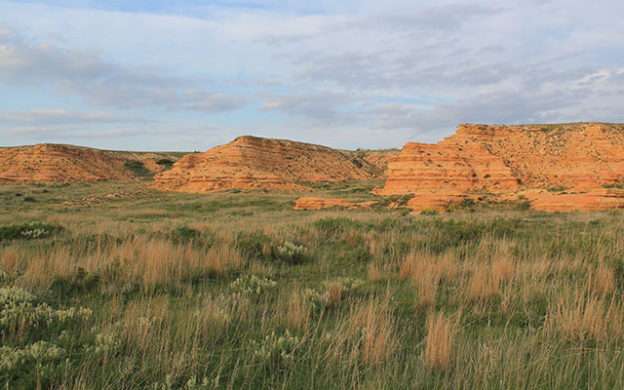
The newly conserved grasslands are in close proximity to the 17,290-acre Smoky Valley Ranch, owned and managed by The Nature Conservancy (Photo: TNC).

The complex of newly conserved properties is located near the Smoky Valley Ranch, which is owned and managed by The Nature Conservancy. The 17,290-acre ranch is identified in the range-wide plan as a potential focal point around which a stronghold could be established.

With additional easements like the ones just finalized, the Smoky Valley Ranch and nearby permanently conserved properties could become a stronghold for the species.

The permanent conservation easements on the private properties were purchased by WAFWA and will be held and monitored by The Nature Conservancy. The easements restrict future development and activities that would be detrimental to the bird’s habitat. All other property rights associated with the land will be retained by the private landowner.

WAFWA, a key partner within the Lesser Prairie-Chicken Initiative (LPCI), has also established an endowment that will provide the landowners with sufficient annual payments to implement a lesser prairie-chicken conservation plan in perpetuity. The primary conservation practice that will be implemented is prescribed grazing, which will be used to maintain sufficient vegetative structure for every phase of the lesser prairie-chicken life cycle. This transaction not only permanently protects key prairie habitat, but also ensures that the properties will remain a working ranch.

“There’s probably no better approach to long-term conservation than a mutually beneficial partnership,” said Matt Bain, Western Kansas Conservation Program Manager for The Nature Conservancy. “It’s been an honor for the us to be a part of this and help these landowners achieve their long-term vision for their ranch.”

The range-wide plan is a collaborative effort of WAFWA; the state wildlife agencies of Kansas, Colorado, New Mexico, Oklahoma and Texas; U.S. Department of Agriculture; U.S. Fish & Wildlife Service; and many non-government conservation organizations. It was developed to conserve lesser prairie-chicken populations by providing another voluntary conservation program for landowner and industry cooperation and improving coordination between state and federal conservation agencies.

Funding for WAFWA’s conservation efforts comes from voluntary mitigation payments by industry partners that are enrolled in the range-wide plan. The plan provides certainty to participants that they will be able to continue operations without interruption.


The Lesser Prairie-Chicken Initiative, led by the USDA’s Natural Resources Conservation Service, is a partnership-based, science-driven effort that uses voluntary incentives to proactively conserve America’s western rangelands, wildlife, and rural way of life.
Fire + Grazing Reduces Wildfire Fuels, Helps Prairie-Chickens, New Research Shows

In 2017, massive wildfires roared over the southern Great Plains, scorching more than 750,000 acres in Kansas, Oklahoma, and Texas. Though wildfires are a natural part of life on the Great Plains, more than a century of fire suppression has set the stage for catastrophic wildfires that have caused unprecedented losses to human life, property, livestock, and wildlife in recent years. How can we effectively reduce wildfire risk? New research shows that by pairing prescribed fire with grazing, range managers significantly reduce wildfire fuels.

The fire-grazing treatment—known as pyric herbivory, or, more commonly, patch-burning—also produces the mosaic of diverse grassland habitat that’s just right for lesser prairie-chickens and other grassland-dependent wildlife.

Read the new research report

In the spring of 2016, a wildfire scorched more than 400,000 acres in Kansas alone, making it the largest wildfire in the state’s history. Until 2017, that is. A massive wildfire in March burned 650,000 acres in Kansas. (photo: Travis Morisse/The Hutchinson News via AP)

On the Great Plains, wildfires are three times more frequent and four times bigger than they were thirty years ago. Some of the biggest increases in both size and frequency have occurred in the southern Great Plains. That’s an immense problem for both people and wildlife.

Led by Dr. Dwayne Elmore of Oklahoma State University, the research team studied the effects of management that used prescribed fire alone (no grazing) versus management that used a combination of fire and grazing known as pyric herbivory, or patch-burn grazing.

What is patch-burning?

Patch-burning mimics the natural duo of forces—fire and grazing—that together shaped prairie-habitat for thousands of years. Ignited by lightning and by native tribes, fire killed encroaching woody plants and prompted the vigorous re-sprouting and germination of native prairie vegetation. This succulent new growth, high in protein-rich forbs, attracted herds of large herbivores, which intensively grazed the recently burned area. The resulting habitat was a mosaic of newly burned areas scattered among grassland patches of varied ages since burning.

Ranchers mimic this process by burning portions of a pasture each year. Livestock are naturally drawn to focus grazing on the tender new growth.

This dynamic tag-team of patchy fire and grazing yields far-reaching benefits to the land—improved soil health and nutrient cycling, increased native plant and wildlife diversity, reduced invasive plants, reduced fuels for wildfire, increased drought resilience, and increased carbon sequestration.

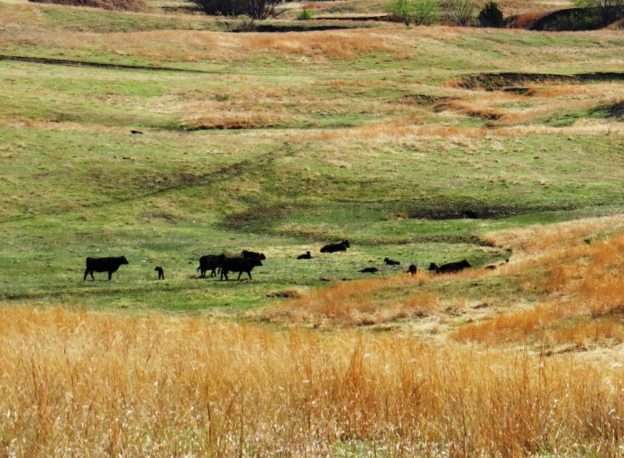
Cattle on the Hashknife Ranch in Kansas graze a section of pasture burned just a few days earlier.

These changes, in turn, yield greater production of higher quality forage for livestock. Previous studies have already shown that patch burning increases overall biodiversity, and that diverse vegetation within a pasture produces greater stability in annual weight gain for cattle.

Why is patch-burning good for prairie-chickens? They need the kind of structurally diverse grassland habitat that patchy fire followed by grazing produces. Lesser prairie-chickens use areas with low-growing vegetation for lekking, tall and dense vegetation for nesting cover, and moderate height vegetation with lots of protein-packed invertebrates (which are known to increase in diversity and abundance following fire) for brooding rearing.

To both benefit prairie-chickens and reduce fire danger, management practices must promote structural diversity and reduce fire behavior characteristics—namely flame length and rate of spread.

What the research found

Patch-burn grazing (pyric herbivory) creates a mosaic of grassland habitat of various ages, density, height, and biodiversity–great for cattle and for lesser prairie-chickens.

The research team’s study shows that prescribed fire alone has limited utility in reducing fuel build-up, since the plant biomass quickly rebuilds in the absence of grazing. On its own, prescribed fire would need to be performed annually to keep the fuel load down. That fire frequency would reduce biodiversity, creating a uniform grassland landscape that lacks the kind of structural and species diversity that lesser prairie-chickens and other prairie wildlife need.

The team found that patch-burn grazing, however, significantly reduced flame lengths and rates of fire spread for an extended period of time. Moreover, subtle changes in weather from day to night—like reduced wind speed and increased fuel moisture—created more significant reductions in flame heights in patch-burned treatments.

The study showed that sites treated with a combination of fire and grazing achieved greater fuels reduction than fire-only sites. Moreover, sites treated with both fire and grazing created the vegetative structure and species mix that best suit prairie-chickens.

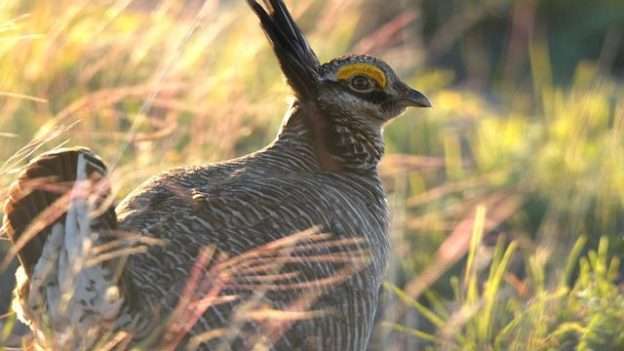
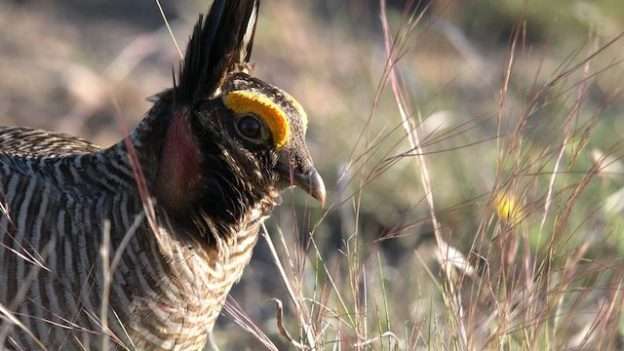
Male lesser prairie-chicken performs his mating display on a lek burned three days earlier on the Hashknife Ranch in Kansas, where rancher Ed Koger has practiced patch-burn grazing for many years.

The take-home for management? Don’t defer grazing on burned areas. As the study puts it, “We add to the evidence that deferment of grazing after fire is not warranted, at least in highly productive rangelands, such as those found in the southern Great Plains.”

“Given the reductions in rates of fire spread, we suggest pyric herbivory [patch-burning] could, if implemented at a landscape scale, result in lower area burned by wildfires in the southern Great Plains.”

That’s mighty welcome news in a fire-prone landscape.

Research and the Lesser Prairie-Chicken Initiative

The Lesser Prairie-Chicken Initiative, led by the USDA’s Natural Resources Conservation Service, helped fund this research. That’s because research studies like this one help ensure that we’re encouraging the right actions in the right places to benefit prairie-chickens. That way, we can strategically direct funds to the places and practices that will yield the greatest conservation return on investment.


The Lesser Prairie-Chicken Initiative is a partnership-based, science-driven effort that uses voluntary incentives to proactively conserve America’s western rangelands, wildlife, and rural way of life.

Final Report Released on 2017 Lesser Prairie-Chicken Aerial Survey

Since 2012, the Western Association of Fish and Wildlife Agencies has overseen an annual aerial survey to estimate the lesser prairie-chicken population across its range in the southern Great Plains. While the initial results were released in June, the aerial survey team has just released its final report detailing the survey results.

The report looks at this year’s survey findings within the context of the last six years of survey data. Over time, the data will provide important insights about population trends of this grassland-dependent bird.

According to the report, researchers estimated the total population size of lesser prairie-chickens to be:

  • 37,108 birds in 2012;
  • 19,471 in 2013;
  • 23,064 in 2014;
  • 28,875 in 2015;
  • 24,779 in 2016; and
  • 33,269 in 2017.

The research team also estimated a 55% increase in the density and abundance of leks (springtime courtship display and mating grounds) in 2017 relative to 2016.

Over the past six years, they estimated the abundance of lesser prairie-chicken leks to be:

  • 3,470 in 2012;
  • 2,228 in 2013;
  • 2,719 in 2014;
  • 1,713 in 2015;
  • 2,053 in 2016; and
  • 3,186 in 2017

Read the full report on our website. 

Healthy, high-quality habitat is the key to lesser prairie-chicken survival and success. With 95% of the lesser prairie-chicken’s habitat on private land, the management practices of private landowners have a tremendous impact on the bird’s population. The Lesser Prairie-Chicken Initiative (LPCI) is all about helping private landowners access technical and financial assistance for voluntary conserve practices that maintain and improve grassland habitat.

During the six-year survey period, the southern Great Plains have experienced significant drought and wildfire. In spite of this, the survey data reveal that population numbers have remained stable.

LPCI science advisor Christian Hagen pointed to the conservation efforts of private landowners as a key factor in that stability. “To show stable populations in the wake of drought and fire, I believe, speaks volumes about the continued conservation efforts occurring across throughout their distribution range,” Hagen said.


The Lesser Prairie-Chicken Initiative, led by the USDA’s Natural Resources Conservation Service, is a partnership-based, science-driven effort that uses voluntary incentives to proactively conserve America’s western rangelands, wildlife, and rural way of life.

New Conservation Agreements Protect Lesser Prairie-Chicken Habitat

The Western Association of Fish and Wildlife Agencies (WAFWA) has finalized permanent conservation agreements with a private landowner to conserve 968 acres of high-quality lesser prairie-chicken habitat in south-central Kansas. In addition, a 160-acre tract owned by another private landowner that is managed with the property will be protected under a 10-year conservation agreement finalized last week. These two tracts of land are immediately adjacent to a 1,781-acre tract which was placed under a permanent conservation agreement earlier this year.

Male lesser prairie-chicken. Photo Jeremy Roberts, Conservation Media

The conserved acreage is all native rangeland currently being managed for livestock production, and this historical use will continue. The permanent conservation easement on the 968-acre tract was purchased by WAFWA and will be held and monitored by Pheasants Forever. Both WAFWA and Pheasants Forever are key partner organizations within the Natural Resources Conservation Service-led Lesser Prairie-Chicken Initiative (LPCI), helping bring about strategic actions that benefit both lesser prairie-chickens and the private landowners that steward their habitat.

“Thanks to conservation-minded landowners, we now have a complex of 2,909 acres being managed with the needs of the lesser prairie-chicken in mind,” said Roger Wolfe, WAFWA’s Lesser Prairie-Chicken Program Manager.  “The ranch is in very good condition due to a long history of good management and there are two active leks on the property.”

The conservation easement restricts future development and activities that would be detrimental to the habitat for the bird. The private landowner will retain all other property rights associated with historical use of the land.

WAFWA has also established an endowment that will provide the landowner with sufficient payments to implement a lesser prairie-chicken conservation plan in perpetuity. This transaction not only permanently protects key prairie habitat, but also ensures that this property will remain a working cattle ranch.

“Pheasants Forever is proud to partner with WAFWA and the private landowners to complete this voluntary conservation easement,” said Jordan Martincich, Director of Development for Pheasants Forever. “The conservation values associated with this project will have a positive impact on wildlife habitat for future generations.  We hope other landowners will partner with Pheasants Forever and WAFWA to perpetually protect their working lands for the benefit of wildlife and the benefit of the ranching community.”

Conservation easements are an important conservation strategy within the Lesser Prairie-Chicken Range-wide Conservation Plan, a collaborative effort of WAFWA and the state wildlife agencies of Kansas, Colorado, New Mexico, Oklahoma, and Texas. The plan was developed to ensure conservation of the lesser prairie-chicken by providing a mechanism for voluntary cooperation by landowners and industry and improving coordination between state and federal conservation agencies.

Male lesser prairie-chicken. Photo Jeremy Roberts, Conservation Media

Funding for WAFWA’s conservation efforts comes from voluntary mitigation payments by industry partners that are enrolled in the plan. The plan allows agriculture producers and industry to continue operations while reducing impacts to the bird and its grassland habitat.

WAFWA’s conservation easements are just one of several conservation assistance programs available to landowners within the lesser prairie-chicken’s range. LPCI’s Conservation Assistance Program brochure includes a table that summarizes several available programs. Contact your local NRCS field office to learn more.

Landowners interested in participating in one of the short-term, long-term or permanent conservation options available under the Lesser Prairie-Chicken Range-wide Plan should contact Roger Wolfe at [email protected].


The Lesser Prairie-Chicken Initiative, led by the USDA’s Natural Resources Conservation Service, is a partnership-based, science-driven effort that uses voluntary incentives to proactively conserve America’s western rangelands, wildlife, and rural way of life.

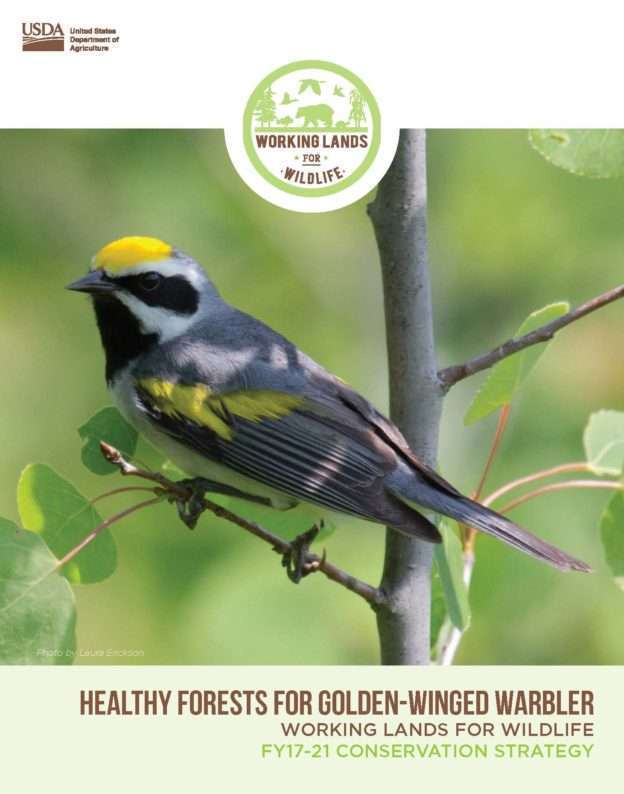
USDA Releases Five-Year Strategy to Boost Forest Health and Help Golden-winged Warbler

The U.S. Department of Agriculture (USDA) has just released a new five-year conservation strategy to support private landowners managing for healthier forests in the Appalachian Mountains, part of an ongoing effort to help the golden-winged warbler rebound, and avoid the need for regulation of the species. This strategy serves as a game plan for how USDA’s Natural Resources Conservation Service (NRCS) and its conservation partners can best meet their goal of helping landowners adopt bird-friendly practices on more than 15,000 acres of young forests and shrublands over the next five years.

The golden-winged warbler has suffered one of the steepest population declines of any songbird species in the last 45 years, largely attributed to the decline of young forests that the migratory bird needs for nesting.

In 2012, NRCS selected seven priority species for Working Lands for Wildlife (WLFW), a science-based partnership for wildlife conservation.  Those species include lesser prairie-chicken, greater sage-grouse, gopher tortoise, New England cottontail, southern willow flycatcher, bog turtle, and golden-winged warbler. More recently, NRCS added the monarch butterfly to its list of priority species.

With a black-and white facial pattern and touches of yellow on its wings and head, the golden-winged warbler breeds in the deciduous forests of the Great Lakes and Appalachians and then spends its winters in Latin America.

Appalachian forests have widely suffered from “high grade” or “diameter limit” harvests that remove only the most valuable trees. NRCS forest conservation practices renew the economic and wildlife values of deciduous forests. With about 70 percent of the region under private ownership, management decisions of landowners are important to the golden-winged warbler and many game species including turkey, deer and grouse.

“Many of our nation’s forests have fallen into poor health, and we have a tremendous opportunity in Appalachia to make a difference both for landowners and for wildlife,” NRCS Acting Chief Leonard Jordan said. “Our effort is to diversify the age classes of trees in forests, creating patches of forests of different ages, and for the golden-winged warbler, we’re focusing on those younger forests within landscapes dominated by mature forests.”

Research shows the conservation practices are benefiting the golden-winged warbler. The largest assessment of its kind is now underway, and the first three years of data show high nesting success in forests managed using NRCS practices.

This strategy provides guidance on how and where the agency will work with landowners to address habitat loss. It relies on new priority areas for conservation, which were developed last fall with support from American Bird Conservancy and assessment data from Indiana University of Pennsylvania, Cornell University and other partners. These priority areas use population, forest cover and land use data to direct conservation actions to key areas across the seven-state range.

For WLFW, NRCS targets conservation in Appalachia, which lost 43 percent of its young forest habitat since the 1960s. From 2012 to 2016, landowners have restored more than 13,000 acres of habitat through WLFW partnerships.

Through Farm Bill conservation programs, NRCS provides technical and financial assistance to help landowners voluntarily plan and implement forestry practices that restore and enhance young forest habitat.

Historically, natural disturbances like wildfires created patches of young forests. Nowa­days, people largely control these natural processes to protect life and property. Through conservation practices, landowners are able to mimic those natural disturbances.

Practices include brush management, creation of conservation cover, early successional habitat development and management, herbaceous weed control and prescribed burning.

Research shows the conservation practices are benefiting the golden-winged warbler. The largest assessment of its kind is now underway, and the first three years of data show high nesting success in forests managed using NRCS practices.

WLFW and other partnership efforts to promote habitat restoration on private and public lands are working. In 2015, the U.S. Fish and Wildlife Service determined protections under the Endangered Species Act were not needed for the New England cottontail and greater sage-grouse, both WLFW target species, largely because of collaborative efforts to conserve habitat on public and private lands. Other successes include the Oregon chub, Arctic grayling, greater sage-grouse, Bi-State sage-grouse and Louisiana black bear.

To learn more about assistance opportunities, landowners should contact their local USDA service center or visit the Conservation Choices for Wildlife – Golden-winged Warbler webpage for more information on available practices.


The Lesser Prairie-Chicken Initiative, led by the USDA’s Natural Resources Conservation Service, is a partnership-based, science-driven effort that uses voluntary incentives to proactively conserve America’s western rangelands, wildlife, and rural way of life.

 New Video Shows how LPC Range-wide Plan Works For Wildlife and Landowners

The Western Association of Fish and Wildlife Agencies (WAFWA) has released a new video demonstrating how the mitigation program in the Lesser Prairie-Chicken Range-wide Conservation Plan is successfully conserving habitat for this iconic grassland bird. The video documents work being done on a West Texas ranch that is being funded by industry participation in the plan.

The video was produced through a partnership between WAFWA, the Natural Resources Conservation Service-led Lesser Prairie-Chicken Initiative, and Pheasants Forever.

Watch the video.

The Range-wide Conservation Plan allows industry to continue operations while reducing and mitigating impacts to the bird and its grassland habitat. Industry contributions support conservation actions implemented by participating private landowners. Pioneer Natural Resources is one of more than 160 companies that are enrolled in the plan.

“Pioneer jumped into this program because it gives us the ability to control our own fate,” said Pioneer VP Legal and Chief Compliance Office Ron Schindler, who appears in the video. “We were able to voluntarily jump in and do some things that would allow us to have some predictability with our future. WAFWA’s expertise helps us select places for production that are less impactful to the chicken first, and on places where we just can’t avoid them, WAFWA also helps us with designs and offsets so that if we impact the chicken in a particular place they get double the habitat elsewhere.”

Randy Beasley’s ranch in Yoakum County in West Texas is a textbook example of how the plan is improving lesser prairie-chicken habitat. Beasley’s ranch has been in his family since 1941. He recalls a time before mesquite invaded the landscape, when lesser prairie-chickens abounded. WAFWA entered into a 10-year contract with Beasley to improve habitat on 15,457 acres of his ranch.

Beasley is implementing a conservation plan developed by WAFWA to increase native grass production and reduce the proliferation of mesquite and shinnery oak. Mesquite and shinnery oak are native plants but their abundance has increased dramatically since historic times due to fire suppression and intensive grazing. Dense stands of these woody plants suppress native grasses, which provide important habitat for the bird as well as forage for livestock.

Recent research shows that lesser prairie-chickens strongly avoid mesquite plants, likely due to their vertical structure. Ideal habitat for prairie-chickens in this region consists of a diverse community of native grasses, forbs, and low shrubs like shinnery oak. Since the contract was initiated in March 2015, more than 2,800 acres of mesquite have been mechanically removed with another 2,400 acres slated for removal. In addition, more than 7,500 acres of shinnery oak has been chemically suppressed.

WAFWA biologists are now working with Beasley to reintroduce fire to portions of the ranch so that the benefits of these restoration practices will be maintained into the future. WAFWA biologists have documented lesser prairie-chickens on the ranch and expect the birds to soon reoccupy areas where recent restoration work has occurred.

“Since we’ve started this wildlife program, we’re starting to see grass grow and we’re seeing chickens again like we did in the past,” Beasley said in the video. “It’s one of those things that is good for us financially. It has been good for the land, for the cattle, and it has been a dream come true.”

The Lesser Prairie-Chicken Range-wide Plan is a collaborative effort of WAFWA and the five state wildlife agencies where the birds are found: Texas, New Mexico, Oklahoma, Kansas and Colorado. The plan was developed to ensure long-term viability of the lesser prairie-chicken through voluntary cooperation by landowners and industry. To date, industry partners have committed over $63 million in enrollment and mitigation fees to pay for conservation actions, and landowners across the range have agreed to conserve over 145,000 acres of habitat through 10-year and permanent conservation agreements.

“It is encouraging to see the progress we’ve made in just a few short years,” said J.D. Strong, Director of the Oklahoma Department of Wildlife Conservation and Chairman of the Lesser Prairie-Chicken Initiative Council. “This new video underscores how private landowners and industry support are making a difference for the long-term survival of the lesser prairie-chicken. Industry and landowner support for conservation efforts are critically important right now as the U.S. Fish and Wildlife Service is moving through the process to determine if the bird warrants being listed again under the Endangered Species Act. We applaud the participation of landowners and industry who care about the future of this species.”

WAFWA video HERE 

Lesser Prairie-Chicken Range-wide Conservation Plan can be found HERE

Aerial Surveys Confirm Lesser Prairie-Chicken Population Holding Steady

Results are in for the 2017 lesser prairie-chicken aerial survey, and they’ve brought welcome news. The survey indicates an estimated breeding population of 33,269 birds this year, up from 24,648 birds counted last year. Though scientists are encouraged by the numbers, they know that year-to-year fluctuations are the norm with upland birds like the lesser prairie-chicken.

Male lesser prairie-chicken flying from a Kansas lek. Photo David Haukos.

“The survey results indicate a 34% increase in the number of birds, but we don’t read too much into short-term population fluctuations,” explained Roger Wolfe, Lesser Prairie-chicken Program Manager for the Western Association of Fish and Wildlife Agencies (WAFWA), the organization that oversees the survey.

“The monitoring technique used for this survey is designed to track trends, which more accurately reflect the amount of available habitat and population stability,” said Wolfe. “The bottom line is that the population trend over the last five years indicates a stable population, which is good news for all involved in lesser prairie-chicken conservation efforts.”

Manuel DeLeon, acting coordinator of the Natural Resources Conservation Service-led Lesser Prairie-Chicken Initiative (LPCI), welcomed the news, noting the essential nature of partnership and collaboration in the process of recovering lesser prairie-chicken populations.

“Moving forward depends on all the collective efforts undertaken to maintain and improve lesser prairie-chicken habitat,” said DeLeon. “LPCI is one cog in the wheel working to help ranchers improve their operations while also improving lesser prairie-chicken habitat.”

LPCI partners with WAFWA to carry out habitat conservation to meet the population recovery goals of the Lesser Prairie-Chicken Range-wide Plan, which was developed to ensure long-term viability of the lesser prairie-chicken through voluntary cooperation by landowners and industry.

Lesser prairie-chickens inhabit four ecoregions in the southern Great Plains, including portions of Colorado, Kansas, New Mexico, Oklahoma and Texas. Their populations regularly fluctuate up and down from year to year due to changes in habitat conditions, mainly influenced by weather patterns. The surveys this year indicated apparent population increases in three of the four ecoregions, with an apparent decrease estimated in the fourth ecoregion.

Lesser prairie-chicken nest with hatched eggs. Photo Jeremy Roberts, Conservation Media.

The short-grass prairie ecoregion of northwest Kansas saw the biggest apparent annual increase in birds, followed by the mixed-grass prairie ecoregion of the northeast Panhandle of Texas, northwest Oklahoma and south-central Kansas. The sand sagebrush ecoregion of southeast Colorado and southwest Kansas also registered an apparent annual increase in the number of breeding birds. An apparent annual population decline was noted in the shinnery oak ecoregion of eastern New Mexico and the Texas Panhandle.

LPCI science advisor Christian Hagen noted that the trends are encouraging, especially on the heels of the extreme drought of 2012-13 and the mega-wildfires that have blazed across hundreds of thousands of acres of prairie-chicken habitat during the past two years.

“While the fire will help the prairies and lesser prairie-chickens in the long run by removing and reducing eastern redcedar, the short term post-fire effects are not well understood,” said Hagen. “To show stable populations in the wake of drought and fire, I believe, speaks volumes about the continued conservation efforts occurring across throughout their distribution range.”

Wolfe noted that, like all wildlife, the health of lesser prairie-chickens is greatly affected by the weather. “The aerial surveys this year were taken before the late spring snowstorm blasted through much of the bird’s range, just prior to the peak of nest incubation,” said Wolfe. “We’ll know more about the impact of that weather event after aerial surveys are completed next year.”


The Lesser Prairie-Chicken Initiative, led by the USDA’s Natural Resources Conservation Service, is a partnership-based, science-driven effort that uses voluntary incentives to proactively conserve America’s western rangelands, wildlife, and rural way of life.
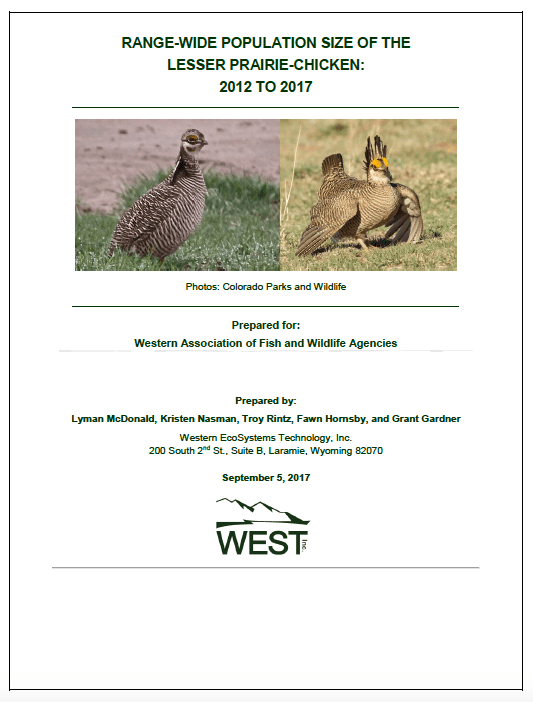
Prairie-chicken Restoration Efforts Take Flight in Southeast Colorado

Why did the lesser prairie-chicken cross the state line?

If Colorado Parks and Wildlife (CPW) biologists are successful, the answer will be to rebuild populations of this uncommon prairie grouse, which has mostly disappeared from the grasslands of the southeast corner of the state.

CPW wildlife biologists Jonathan Reitz and Liza Rossi recently completed a month-long effort to catch and relocate lesser prairie-chickens from stronghold populations in Kansas. It’s part of a joint four-year operation between CPW, the Kansas Department of Wildlife, Parks and Tourism, and the U.S. Forest Service to rebuild prairie chicken populations in a 330,000-acre swath of southeastern Colorado and southwestern Kansas.

Liza Rossi, Colorado Parks and Wildlife Bird Conservation Coordinator, and Trent Delahanty, CPW technician, release two lesser prairie-chickens on the Comanche National Grasslands during a recent relocation from Kansas.

The target recovery area includes privately owned rangeland, Conservation Reserve Program grassland, the Cimarron National Grassland in Kansas, and the Comanche National Grassland in Baca County, Colorado. Both the Cimarron and Comanche grasslands are owned and managed by the U.S. Forest Service.

Historically, the region was home to large flocks of lesser prairie-chickens, but populations have fallen significantly since Euro-American settlement. By 2016, biologists counted just two males on the Comanche Grassland and five males on the Cimarron.

Christian Hagen, science advisor to the Lesser Prairie-Chicken Initiative (LPCI) notes that, while translocating birds is a last resort in conservation triage, it can be effective when done in concert with habitat management or restoration.

“Conservation efforts such as those underway through LPCI and WAFWA [the Western Association of Fish and Wildlife Agencies] can help bolster these fragile translocated populations as they make their way in an unfamiliar landscape,” Hagen said.

Both LPCI and WAFWA offer technical and financial assistance to private landowners, who own and manage 95% of the land within the lesser prairie-chicken’s current range, to improve grassland habitat, benefitting both the bird and agricultural operations.

Abby Athen, Kansas Department of Wildlife, Parks and Tourism, uses calipers to measure a male lesser prairie-chicken.

Last fall, Reitz and Rossi relocated 13 males and one female to Comanche National Grasslands. This spring, they relocated an additional 19 hens and 29 roosters. And they have ambitious goals over the next two years, targeting around 120 lesser prairie-chickens for relocation to Colorado.

But the biologists are discovering a big problem with relocating the birds. Roosters naturally gather in what is known as a “lek” to perform displays designed to attract hens for mating. But they don’t adapt well when their lek is disrupted, often taking flight after relocation in hopes of returning to their home leks.

“Their home lek is the center of their universe,” Reitz said. “Many relocated birds appear to be very unsettled, having been removed from that center.”

“We have observed several prairie chickens having traveled 30 miles or more from the release site,” he said.

CPW biologists are hopeful that the new project, which targets a large number of birds and uses sophisticated technology to retain and track the birds, will succeed.

In the current project, each relocated bird is being banded and outfitted with a radio transmitter. CPW crews on the ground and in the air track the movements of the birds. The transmitters emit a distinct signal when the bird has died, so CPW staff can find them and try to determine a cause of death.

Biologists are employing some high-tech devices to trick the prairie-chickens into staying put after relocation. At release sites, CPW staff is deploying “call boxes” programmed to play cackles and other sounds male lesser prairie-chickens make when displaying on a lek.

“We have technicians on the ground tracking the birds as they spread out,” Reitz said. “We will be using an airplane to find them and point our technicians in the right direction. So we can determine if hens are nesting and whether they succeed in hatching chicks.”

Already, CPW biologists are seeing signs of success. Several of the recently relocated birds are remaining in the release area. And recently, CPW technicians documented a group of relocated birds “booming” together.

More trapping is planned in April 2018 and 2019. A doctoral candidate from Kansas State University will join the project this coming August to assist with the data collection and analysis as tracking and research of the birds’ movements proceeds.

Stay tuned for updates!

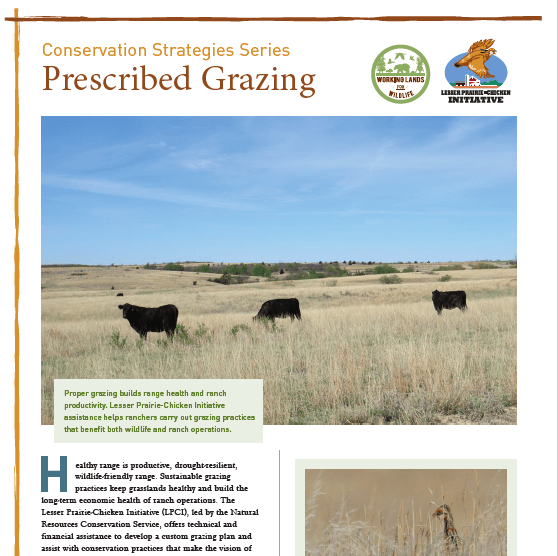
New Conservation Strategy Series: Prescribed Grazing Builds Healthy Grasslands

Our Conservation Strategies Series of fact sheets identify and describe LPCI’s core conservation strategies, which benefit ranch operations while improving habitat for the lesser prairie-chicken. Our latest fact sheet highlights prescribed grazing.

Download the fact sheet. 


Healthy range is productive, drought-resilient, wildlife-friendly range. Sustainable grazing practices keep grasslands healthy and build the long-term economic health of ranch operations. The Lesser Prairie-Chicken Initiative (LPCI), led by the Natural Resources Conservation Service, offers technical and financial assistance to develop a custom grazing plan and assist with conservation practices that make the vision of healthy rangelands a reality.

Good grazing takes careful planning. At a rancher’s request, LPCI range management specialists assess range conditions and ranch infrastructure to craft a conservation plan. Every grazing plan identifies conservation practices tailored to the needs and goals of the ranch operation, including such practices as water development, brush management, prescribed fire, rest rotation, deferment, and seeding. LPCI financial assistance helps ranchers carry out those practices.

Good planning develops contingencies for changing conditions, like drought. Every LPCI grazing plan includes a drought contingency plan that lays out a clear course of action to minimize long-term damage to the range. That’s good for the ranch’s bottom line, and it’s good for prairie wildlife.

Prescribed Grazing, Step by Step

1. Contact NRCS. Talk one-on-one with NRCS range conservationists to learn about options for getting involved in prescribed grazing. All NRCS assistance programs are voluntary and all conversations are confidential.

2. Planning. Our first step with landowners who take part in LPCI assistance programs is to evaluate existing conditions and develop a conservation plan.

3. Recommend Grazing Utilization. By carefully assessing forage production, the conservation plan identifies sustainable grazing utilization, which can spell the difference between robust range and range that’s over-utilized and damaged.

4. Plan for Drought. Quick, specific, science-based planning for the inevitable droughts of the southern Great Plains helps avoid long-term damage to the range.

5. Custom conservation practices. Water development to distribute grazing, brush management to remove encroaching woody plants, prescribed fire to restore range health, rest rotation and deferment—these are just a few of the conservation practices LPCI helps support.

6. Monitoring. How do we know if the conservation plan is having its intended effect and is doing well by the land and by the landowner? By monitoring range production and utilization.

Benefits of Prescribed Grazing

  • Drought resilience
  • Improved grass & forb species mix
  • More and better quality forage
  • Decreased soil erosion
  • Healthy habitat for wildlife


Rancher Spotlight

Russell Blew, Kansas

“We implemented an EQIP contract on this ranch that included brush management and prescribed grazing,” says Kansas rancher Russell Blew. “By clipping that grass and seeing what species we have out there, seeing what condition the range is actually in, we can put a finer point on our stocking rate. Some people figure 10 acres per cow-calf pair, some people say 8. When you start talking about a herd size of 100 to 200 cow-calf pairs and maybe even more than that, you really need to know how much grass is in a particular paddock. NRCS’s technical support brings some actual science into it.”

“Implementing those practices long term, it’s incredible to see the benefit of the range. We’ve seen desirable [plant] species get a lot better and undesirable species subside. We’re looking at 50-60 years of abuse in a lot of instances, and so it’s going to take more than a few years to get it fixed back up.”

“[NRCS’s] initial role is to help a guy get started and show him that by stocking the range properly, by rotationally grazing it and cutting some trees, he’d see how much better the range is, and then he’d implement those practices, maybe not just for the duration of the contract,  but for the duration of the operation of the land.”

To learn more about LPCI assistance, contact your local NRCS office. 


The Lesser Prairie-Chicken Initiative, led by the USDA’s Natural Resources Conservation Service, is a partnership-based, science-driven effort that uses voluntary incentives to proactively conserve America’s western rangelands, wildlife, and rural way of life.

New Mesquite-Removal Factsheet Spotlights Conservation Strategy for Landowners

The latest offering in LPCI’s Conservation Strategies Series gives private landowners an overview of the hows and whys of mesquite removal as a core conservation practice that benefits both ranch operations and prairie wildlife.

You can download the Mesquite Removal Conservation Strategies Series fact sheet (PDF), or read the story below: 

Conservation Strategies Series: Mesquite Removal

When mesquite overtakes grasslands, both livestock and prairie wildlife lose out. Removing mesquite increases forage production and improves habitat for lesser prairie-chickens and other grassland-dependent species.

For ranchers in Texas and New Mexico, honey mesquite encroachment can pose a real problem. Mesquite outcompetes desireable grasses and forbs. If a ranch’s stocking rates remain the same as mesquite cover increases, overgrazing can result, reducing the grassland’s health and resiliency.

While honey mesquite is a natural part of the prairie ecosystem in this region, its density has increased since the late nineteenth century due to suppression of natural fires and spreading of mesquite seed by domestic livestock. Depending on the site and climate, honey mesquite can grow to 25 feet in height with main stems as large as 2 feet in diameter.

Mesquite isn’t just a problem for livestock forage production—it’s a problem for native wildlife. Studies show that lesser prairie-chickens greatly prefer
landscapes with less than 1% mesquite canopy cover. That’s likely because mesquite provides hiding and perching sites for predators.

The prairies of North America evolved under the tag-team disturbances of bison grazing and fire. Bison herds grazed infrequently but intensely. Areas that went ungrazed built up dry fuels that supported wildfires that kept mesquite shrubs in check. Historic cattle ranching brought continuous and often heavy grazing that reduced the grass fuel load needed to carry wildfires.

Benefits of Mesquite Management

  • Increased grassland acreage and productivity, meaning more forage for cattle and more grassland habitat for wildlife.
  • Increased nutrients and water available for grasses and forbs.
  • Increased grassland health, which provides more resiliency and options for producers when drought hits.
  • Increased surface water flow and groundwater recharge for springs.

Managing Mesquite

Killing the plants. Chemical treatment of mesquite can effectively kill mesquite, if done under the right conditions. While hand spraying has the greatest accuracy, it’s very expensive, so aerial spraying is a commonly used option.

Removing the skeletons. Killing the mesquite plant isn’t enough. The mesquite plants continue to occupy potential grassland space, limiting forage production for livestock. What’s more, studies show that prairie chickens avoid mesquite shrubs whether or not they have leaf cover. The above-ground structure of mesquite can be removed by grubbing (digging the root system up with an excavator) or mowing.

Preventing re-encroachment. Prescribed fire is the least expensive of the treatment methods—a cost-effective way to prevent reencroachment. Fire suppresses young mesquite seedlings and limits the number of seed-bearing plants. Older mesquite plants will resprout following fire.

Rancher Spotlight: Bret Riley, New Mexico

Texas rancher Bret Riley, photo Jeremy Roberts, Conservation Media

In his Own Words: “The one thing my grandpa used to tell me over and over is that if you take care of your country it’ll take care of you. I think that’s where it starts.”

“The most practical way to control mesquite is by spraying it by aircraft, and that’s what we’ve started doing. Mesquite is hard to kill, and the timing of it is critical. We’ve had one pasture we’ve been planning on spraying for the last three years, and we haven’t got it sprayed yet just because the climatic conditions haven’t been right.”

“In areas that have been treated—the next year even—the grass back in there will be unbelievable because of the amount of moisture that is available, especially in an ecosystem like this where we’re short [on water].”

To learn more about LPCI assistance, contact your local NRCS office. 


The Lesser Prairie-Chicken Initiative, led by the USDA’s Natural Resources Conservation Service, is a partnership-based, science-driven effort that uses voluntary incentives to proactively conserve America’s western rangelands, wildlife, and rural way of life.