Author Archives: Greg Peters

Pheasants Forever Provides Critical Support for Lesser Prairie-Chicken and Sage Grouse Efforts

Simply put, the Natural Resources Conservation Service’s Working Lands for Wildlife (WLFW) efforts would be far less effective without our network of partners. In the Great Plains and West in particular, the the Lesser Prairie Chicken Initiative (LPCI) and the Sage Grouse Initiative (SGI) benefit immensely from these partnerships.

Few WLFW partners have been as important as Pheasants Forever, particularly for LPCI and SGI. Pheasants Forever recently highlighted its cross-species work in two articles in the Spring 2019 Pheasants Forever Journal of Upland Conservation magazine.


Download and read this article to learn how Pheasants Forever works through partnerships like LPCI and SGI.


While it may seem counterintuitive that a group with “pheasants” in its name would work on sage grouse and lesser prairie-chickens, Ron Leathers, PF’s public finance director, explains the group’s motivation:

“We want to be true to our core, but our mission says ‘and other wildlife,’ and we’re thrilled to help other upland gamebirds when we can benefit pheasants and quail too. Our work on prairie chickens and sage grouse creates a lot of crossover that benefits pheasants and quail too.”

One specific example of how Pheasants Forever supports WLFW’s efforts is through the SGI Field Capacity Coordinator position, staffed by Michael Brown. Funding for the position comes from SGI, but Pheasants Forever is Brown’s employer.

In his role, Brown coordinates on-the-ground conservation through a network of staff who work directly with ranchers and producers to implement projects. This can help build trust with producers who may not want to work directly with the federal government by allowing them to work with an NGO to access resources and assistance provided by NRCS. Brown explains the benefits:

“If producers don’t want to work with the federal government, for whatever reason, they don’t have to. In my experience, we’ve found that people are more willing to work with Pheasants Forever at the beginning because we’re not the government, even though the work might be funded by federal dollars. Then they choose to work with us on subsequent phases of a project because they see that we get work done efficiently and comprehensively.”


Download and read this article to learn more about how Pheasants Forever is helping numerous upland gamebirds, including lesser prairie-chickens.


This approach is precisely why SGI and LPCI have been able to work with thousands of producers to benefit millions of acres of habitat for lesser prairie-chickens, sage grouse, and other wildlife.

Download the stories to read more about how Pheasants Forever plays a key role in benefiting working lands for ranchers, communities, and wildlife. Be sure to check out Pheasants Forever’s website to learn more about this key WLFW partner.

WEBINAR: Mapping Cross-Scale Transitions in Rangelands

UPCOMING WEBINAR | FEBRUARY 26, 2019 | 2 PM EASTERN TIME

Mapping Cross-Scale Transitions in Rangelands

WATCH ON DEMAND REPLAY HERE >

Join NRCS Working Lands for Wildlife researchers from the University of Nebraska-Lincoln and the University of Montana for this webinar. Learn how new technological innovations in rangeland monitoring are allowing unprecedented tracking of vegetation response to wildfires, brush management, and drought.

This hour-long webinar is focused utilizing the powerful new Rangeland Analysis Platform in the Great Plains ecosystem to improve rangeland management.

The Rangeland Analysis Platform (RAP) is a new mapping technology that allows for the tracking of vegetation change at unprecedented scales in both space (United States rangelands from the Great Plains to the Pacific Ocean at a 30-m resolution) and time (annually from 1984–present). The RAP is free, readily available online, and developed for use by landowners and natural resource managers to track vegetation through time and plan actions to improve America’s grazing lands.

The RAP can be used to inform strategies to improve productivity of grazing lands, manage weeds, mitigate impacts of wildfire and drought, and benefit wildlife habitats. Powered by Google Earth Engine, RAP merges machine learning and cloud-based computing with remote sensing and field data to provide the first-ever annual cover maps of rangeland vegetation. This new platform, when combined with local knowledge, allows users to better understand vegetation change through time and to aid in conservation planning and outcome evaluation. This webinar provides an overview of the innovative breakthrough in the monitoring of rangeland vegetation and examples of how the technology is being applied to advance key missions of existing science-agency-landowner partnerships in the Great Plains.

WATCH ON DEMAND REPLAY HERE >

(No pre-registration required)


Presenters:

  • Dr. Dirac Twidwell, Associate Professor of Rangeland Ecology, University of Nebraska, Lincoln, NE.
  • Dr. Brady Allred, Associate Professor, Rangeland Ecologist, University of Montana, Missoula, MT
  • Dr. Matthew Jones, Research Scientist, University of Montana, Missoula, MT

CEU Credits / Certifications offered:

  • Society for Ecological Restoration (SER) – 1 hour SER-CERP Credit   [credits applied for]
  • Society for Range Management (SRM) – 1 hour SRM Credit   [credits applied for]
  • Certified Crop Advisors (CCA) – 1 hour CCA – CM Credit
  • Certificate of Participation

Meet the “New” West Working Lands for Wildlife communications team: Brianna Randall and Greg Peters

Without Telling Our Story, It’s Just a Bunch of Work


This post is from Tim Griffiths, West Working Lands for Wildlife Coordinator. Tim wanted to take a moment to formally introduce Brianna Randall and Greg M. Peters, two members of the Working Lands for Wildlife team focused on communications.


The USDA Natural Resources Conservation Service’s Working Lands for Wildlife conservation effort focuses on getting strategically targeted conservation on the ground, working directly with private landowners to make lands and habitats more productive across the country. In the West, much of our work focuses on conserving the working sagebrush rangelands of the Intermountain West and the productive prairies of the southern Great Plains. Although sage grouse and lesser prairie-chicken benefit greatly from this work, so do hundreds of other species, including people.

We are proud of the landscape-scale conservation work accomplished in these landscapes over the past decade, work that’s good for the bird and good for the herd. Can you believe that these Working Lands for Wildlife partnerships (through the Sage Grouse Initiative (SGI) and Lesser Prairie-Chicken Initiative (LPCI)) have teamed up with more than 2,650 ranches to conserve 8.6 million acres? That’s simply incredible! Perhaps even more impressive however are the personal and unique stories behind those statistics.

The NRCS’s Working Lands for Wildlife effort focuses on many wildlife species, including lesser prairie-chicken and sage grouse.

Without a solid communications program that captures and shares these amazing success stories, the numbers are just that – numbers. We need to continually share the personal side of these win-win stories and highlight the innovative new science that’s helping us be both more efficient and effective at delivering conservation. Through this sustained outreach, we’ll continually increase conservation of working western landscapes.

Over the years, we’ve had a few different folks helping our Natural Resources Conservation Service public affairs professionals with communications for both SGI and LPCI.

This year, we’re excited to introduce a team of communicators who will help take Working Lands for Wildlife, and especially LPCI and SGI, communications to a new level.


Brianna Randall may be familiar to folks who have followed SGI over the past several years. She’s been the communications coordinator for SGI since 2015. In that time, she’s helped highlight our successful science-based conservation work in sagebrush country by writing and publishing stories about incredible ranchers and partnerships who have stepped up to make a difference for working lands and wildlife. She’s also helped capture and share the resulting benefits for the wildlife.

Brianna Randall behind the camera at the 2017 Sage Grouse Initiative Workshop in Gunnison, CO.

Fortunately, Brianna is continuing to work on with the Working Lands for Wildlife team as a writer, producing the same compelling content she’s been generating for years. Only now, her geography has expanded to include the landscapes of the southern Great Plains. We’re thrilled to have Brianna continue writing about proactive conservation on western rangelands.


We’re equally excited to introduce a new addition to the team. Please help us in welcoming Greg M. Peters as our new Working Lands for Wildlife communications coordinator. Greg will be taking over much of the day-to-day communications for SGI and LPCI and will manage our website, social media accounts, and develop content in coordination with Brianna and all our excellent NRCS public affairs leads. Greg will be re-energizing our communications as well by developing and sharing new stories. Stay tuned for more content in the coming weeks as Greg gets fully up to speed.

Greg Peters is the new WLFW communications coordinator focused on LPCI and SGI.

Please join us in welcoming Greg and Brianna in their new roles. They are both excited to continue sharing news about the partners, landowners, and science-based conservation practices that are helping improve the Great Plains and sagebrush country. If you have ideas or opportunities, please let us know!

You can reach Brianna Randall at [email protected].

You can reach Greg Peters at [email protected].

Research Says, Adjusting Grazing Practices Can Improve Prairie-Chicken Habitat

When it comes to creating the diverse grassland structure that lesser prairie-chickens need, prescribed burning–and particularly patch-burn grazing–is a go-to, cost-efficient management strategy. But weather conditions in the semi-arid southern Great Plains can stand in the way of implementing prescribed fire plans. That’s why range managers need a variety of conservation practices in their toolbox to create and maintain the mosaic of grassland habitat that lesser prairie-chickens and other grassland-dependent wildlife species depend on.

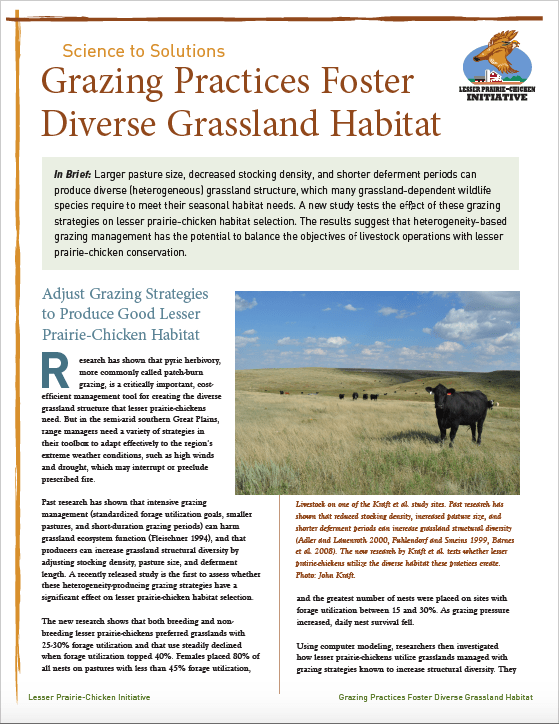
A new study by researchers at Kansas State University identifies specific grazing practices—targeted forage utilization goals, decreased stocking density, and larger pastures—that create the varied grassland habitat structure that lesser prairie-chickens need. The latest Science to Solutions report from the Natural Resources Conservation Service-led Lesser Prairie-Chicken Initiative describes the research and what it means for on-the-ground management strategies.

Read the Science to Solutions report, “Grazing Practices Foster Diverse Grassland Habitat.”

What the Study Found

Past research has shown that intensive grazing management (standardized forage utilization goals, smaller pastures, and short-duration grazing periods) can harm grassland ecosystem function, and that producers can increase grassland structural diversity by properly adjusting forage utilization goals, decreasing stocking density, and increasing pasture pasture size.

The recently released study, led by John Kraft, is the first to assess whether these structural diversity-producing grazing strategies have a significant effect on lesser prairie-chicken habitat selection.

The new research shows that  non-breeding lesser prairie-chickens preferred grasslands with 35-45% forage utilization and that use steadily declined when forage utilization topped 50%. Breeding females placed all nests in pastures with less than 40% forage utilization, and the greatest number of nests were placed on sites with forage utilization between 0 and 20%. As grazing pressure increased, daily nest survival fell.

Using computer modeling, researchers then investigated how lesser prairie-chickens utilize grasslands managed with grazing strategies known to increase structural diversity. They found that, regardless of the forage utilization value, lesser prairie-chicken habitat use increased significantly with lower stocking densities, and that larger pasture size increased habitat use. Their findings have important implications for range management within the lesser prairie-chicken’s active range in the southern Great Plains.

What it Means for Range Management

Female prairie-chickens nest in habitat with tall, dense vegetation, then move their broods to habitat with more insect-rich forbs and more bare ground, which allows for greater mobility for chicks. When range management does not create adequate grassland structural variety to meet changing seasonal needs, lesser prairie-chicken populations decline. (Photo: David Haukos)

Stocking density is a crucial indicator for maintaining or improving lesser prairie-chicken habitat. Many ranchers have adopted intensive grazing management practices in which pastures are subdivided into smaller paddocks. This increases stocking density and reduces the quality of the resulting habitat for lesser prairie-chickens. Range managers can reduce stocking density by selectively removing cross fencing to make pasture areas bigger, shifting toward a continuous grazing system. While there is much debate on the merits of rotational and continuous grazing systems, the superiority of one system over another in terms of livestock production and ecosystem health is not widely accepted among professionals.

In rangelands that already have the diverse vegetative structure that lesser prairie-chickens require, range managers can maintain large-scale (i.e., across pastures) heterogeneity through a mix of low-to-moderate forage utilization goals between pastures. Small-scale heterogeneity (i.e., within pasture) can be maintained by implementing low stocking densities, greater pasture areas, and shorter deferment periods.

In rangelands where vegetative structure suitable for nesting is limited, or where the most important grass species for nesting are also among the most palatable, longer deferment and rest-rotation may be needed to restore or create advantageous vegetative structure. Further, periodic, year-long deferment is likely essential to maintain the integrity of grazed lands regardless of plant community composition.

The Science to Solutions report identifies specific management practices to improve lesser prairie-chicken habitat–Read them on page 4 of the report.

The bottom line? While the combined effects of prescribed fire and grazing (patch-burn grazing) offer an exceptional tool for optimizing lesser prairie-chicken habitat and livestock production, a particular assemblage of vegetative diversity-promoting grazing practices can help maintain and improve lesser prairie-chicken habitat when range conditions preclude the use of fire.

Patch-Burn Grazing Fires Up Prairie-Chicken Habitat

For lesser prairie-chickens, good habitat is a complex thing. Structural diversity is key, because a prairie-chicken’s habitat needs change with the seasons. While courtship sites (leks) tend toward short-statured vegetation, females prefer to nest in tall, dense grassland vegetation, then move their chicks to more open, forb-dominated, insect-rich habitat.

New research shows that patch-burn grazing creates the mosaic of grassland habitat structure that prairie-chickens depend on. A new Science to Solutions paper from the Lesser Prairie-Chicken Initiative (LPCI) describes the research and its implications for range management.

Read the Science to Solutions story

The research team, led by Jonathan Lautenbach of Kansas State University, addressed two central questions: How does patch-burn grazing influence grassland composition and structure? How do lesser prairie-chickens use the mosaic that patch-burn grazing creates?

Lautenbach found that, throughout the year, females chose vegetation patches where the combined effects of fire and grazing produced vegetation characteristics that matched their changing seasonal needs. Specifically, females selected greater time-since-fire patches (>2-years post-fire) for nesting, 2-year post-fire patches during the spring lekking season, 1- and 2-year post-fire patches during the summer brooding period, and 1-year post-fire units during the nonbreeding season.

Researchers have also found that patch-burn grazing yields good livestock performance by stabilizing weight gain in the face of rainfall fluctuations. That means patch-burn grazing offers a successful strategy to significantly improve both lesser prairie-chicken habitat and livestock production.

Historic Forces: The Dynamic Duo of Fire and Grazing

Historically, fire and grazing acted together to shape prairie vegetation. Ignited by Plains Indians and lightning, fire killed encroaching woody plants and prompted the vigorous re-sprouting and germination of prairie vegetation. This succulent new growth of grasses and forbs attracted herds of large herbivores, which selectively grazed the recently burned area. The resulting landscape was a mosaic of burned areas scattered among grassland patches of varied ages since burning.

Most current range management in the Great Plains decouples fire and grazing. When fire is over-applied (for example, by burning entire pastures), livestock don’t have the choice between burned and unburned prairie, and a uniform grassland structure results. On the other end of
the management spectrum, fire suppression also reduces grassland structural and species diversity.

Grassland uniformity reduces drought resiliency, which decreases livestock productivity. Uniformity also negatively impacts grassland wildlife, particularly grassland birds, since some species require varying vegetation structure across the landscape to complete their life cycles.

Further, without regularly occurring fires, fire-intolerant woody plants encroach, significantly reducing both livestock forage and grassland wildlife habitat (see LPCI’s Science to Solutions #1 on redcedar encroachment and Science to Solutions #3 on mesquite encroachment).

Male lesser prairie-chicken on a lek (mating display area) within the patch-burn grazing study area. The lek site had been burned just three days earlier. Photo: Jonathan Lautenbach.

What the Science Means for Management

The Natural Resources Conservation Service-led Lesser Prairie-Chicken Initiative provides technical and financial assistance to farmers and ranchers to voluntarily improve habitat for lesser prairie-chickens. Lautenbach’s study, funded in part by LPCI, helps identify which range management strategies are most effective in benefitting bird and herd.

Patch-burned pasture within Lautenbach’s study site on the Hashknife Ranch in south-central Kansas.

Past research has shown the clear benefits of patch-burn grazing on livestock productivity. Specifically, cattle in pastures with two or more patches gained weight independent of rainfall, indicating that patch-burn grazing helps buffer climatic variation and stabilizes livestock productivity—a critically important attribute in the drought- prone southern Great Plains.

Also, research shows that, while both conventional prescribed burning and patch burning reduce wildfire fuels and redcedar encroachment, patch-burning does so while maintaining habitat for grassland-dependent wildlife.

Lautenbach’s study adds to evidence of the win-win nature of patch-burn grazing for livestock and wildlife, specifically showing that lesser prairie-chickens use the diverse patchwork to meet their needs for nesting, brood- rearing, and over-wintering.

The findings show that the scale and configuration of prescribed burns really matter. During the study, no females were observed nesting in year-of-fire patches, which lack thermal and hiding cover. Creating a mosaic of grassland patches of varied age-since-fire (rather than conventional whole-pasture burning) is a crucial part of the conservation equation.

To achieve the combined conservation strategies of removing redcedar and increasing grassland heterogeneity, Lautenbach’s research team recommends implementing prescribed fire in a patch-burn grazing system with a 4-6 year burn interval for any given patch.

The researchers note that their study was conducted in the eastern portion of the lesser prairie-chicken’s distribution. Regional differences in rainfall, soil types, and vegetation, create four different eco-regions, across the lesser prairie- chicken’s occupied distribution in the southern Great Plains. Within these ecoregions the recommended fire return interval will change, with areas receiving less rainfall having a greater fire-return interval (e.g. 7-10 years for any given patch).

Check out all of LPCI’s Science to Solutions papers on LPCI’s Resources page.

Seeing the Prairie From a Coyote’s Eye View

by Marina Osier

The NRCS-led Lesser Prairie-Chicken Initiative partners with Pheasants Forever and other organizations to fund field staff positions in communities within the lesser prairie-chicken’s active range. LPCI field staff work one-on-one with landowners, offering technical assistance that helps landowners take part in voluntary conservation assistance programs that benefit lesser prairie-chicken habitat. Marina Osier is an LPCI range conservationist based in Lamar, Colorado.


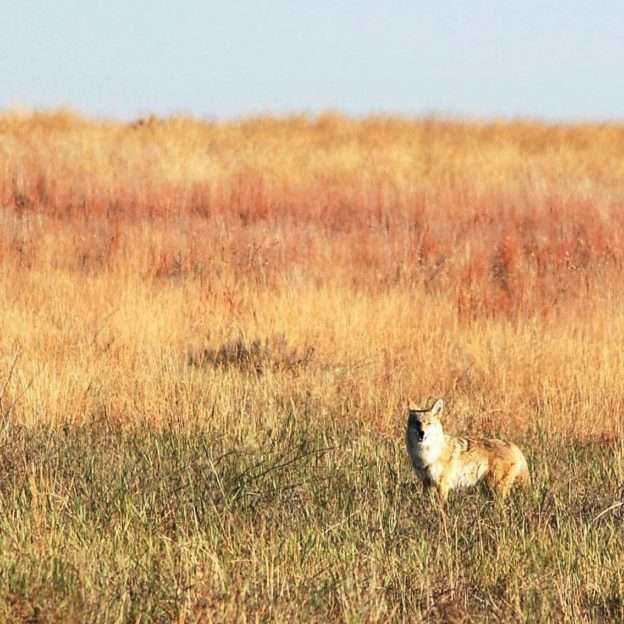
Coyote, southeastern Colorado. Photo: Marvin Watson, NRCS

I recently saw a coyote running through a field with what looked suspiciously like a pheasant in its mouth, and it struck me that good grassland habitat is a matter of perspective.

When biologists go out to assess wildlife habitat, it’s easy to look at it from the perspective of who we are – humans. We may look out across the rangeland and see what we think looks like good cover for grassland birds. But if we get down on hands and knees and look at that same habitat, things can look a lot different. We might see that there’s actually excessive bare ground that isn’t the best cover after all. That difference in perspective begs the question – why do birds such as lesser prairie-chickens, pheasants, and quail need a certain type of cover to begin with? Who are they hiding from?

There are many factors that influence grassland bird survival, but one important factor is predators. Who preys on these birds? For one, coyotes. And coyotes have a different perspective on the prairie than we do. They don’t stand 5-6 feet tall and look out over the grassland to the horizon. No, they work their way through the grass and search on a much closer scale. And that’s why, when we monitor vegetation on land enrolled in the NRCS Lesser Prairie-Chicken Initiative (LPCI) or the Western Association of Wildlife Agencies (WAFWA) Range Wide Plan (RWP), we include an assessment that looks at the habitat from a coyote’s eye.

Range conservationists in New Mexico use a Robel pole during vegetation monitoring. Photo: Jake Swafford

This assessment is called the Visual Obstruction Reading (VOR), and is measured with a Robel pole. To measure VOR, I stand 6.5 feet from the Robel pole and crouch down until my eye is 1.5 feet above the ground. Then I look at the striped pole and record how much of the pole is obstructed by vegetation.

By doing that at regular intervals along a transect line, range conservationists can get a sense of the hiding cover available to lesser prairie-chicken and can recommend conservation practices that optimize that cover.

Research shows that lesser prairie-chickens tend to select nest sites in grasslands with high VOR readings. Once the eggs hatch, females guide chicks to areas with a more bare ground and more insect-attracting forbs (where chicks can move about more freely and eat nutrient-rich bugs), though still with enough cover to elude predators.

Looking at the prairie from a coyote’s eye view helps land managers help lesser prairie-chickens. Keeping a broad perspective is an important part of managing habitat for healthy grassland bird populations.

A Tale of Two Fires: Prescribed Fire Thwarts Wildfire on the New Mexico Prairie

Two lightning-caused wildfires on the same site in eastern New Mexico yielded profoundly different results. Why? Prescribed fire played a key role.

On June 10, 2009, lightning sparked a fire in remote grasslands some 30 miles east of Roswell, New Mexico. Strong winds whipped the flames, stoking a plume-dominated wildfire—the term for fire so hot it creates its own weather and wild, unpredictable winds. By the time firefighters fully contained the Cato Fire three days later, more than 55,000 acres—86 square miles—had burned.

Fast forward eight years to July 2017. Lightning again ignited a wildfire in the same area as the 2009 fire. But this one, called the East Cato Fire, burned just 372 acres before dying out for lack of fuel. Why the profoundly different outcomes from two lightning-caused wildfires in the same location? Prescribed fire played a critical role.

About two-thirds of the acreage that burned in the 2009 wildfire lies within the boundaries of Sand Ranch, a 58,600-acre federally owned parcel 35 miles east of Roswell. It’s managed by the Bureau of Land Management (BLM) as habitat for the lesser prairie-chicken, an imperiled species of prairie grouse that inhabits the southern Great Plains.

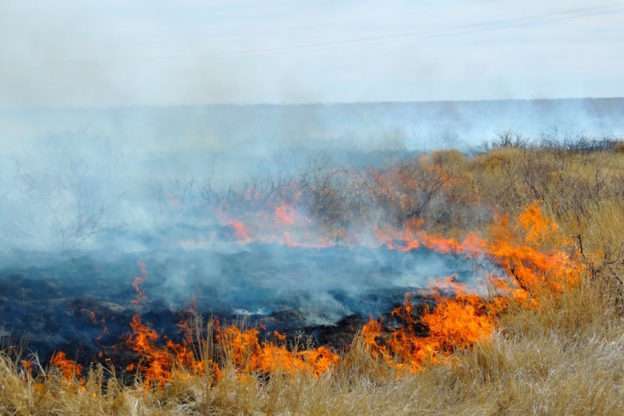
BLM wildlife biologist Randy Howard lights a prescribed fire on the Sand Ranch in eastern New Mexico. Prescribed fires reduced fuel loads on the land, which in turn reduced the spread of the East Cato wildfire in July 2017.

Sand Ranch encompasses a big swath of potential lesser prairie-chicken habitat, but there’s a whole lot more to good habitat than sheer acreage. Like many other grassland birds, prairie-chickens need diverse grassland structure—a mosaic of grassland patches with varied structure that meets their particular needs throughout the year.

Historically, a closely entwined duo of natural forces—fire and fire-influenced grazing by bison and other large herbivores—created that essential patchwork of grassland habitat. Decades of fire suppression and altered grazing patterns shifted that dynamic, reducing both the structural and species diversity of prairie grasslands.

Because of this, the BLM made careful plans to reintroduce fire to Sand Ranch through prescribed burning. It wasn’t a decision lightly made. While low-intensity fire can help create the vegetation mosaic lesser prairie-chickens need, an uncontrolled, high-intensity fire can destroy nesting habitat, plus a whole lot more. This is dry country and aversion to fire runs deep.

Local rancher Kyle Dillard voiced a common fear as he recalls a wildfire that came on the heels of the intense drought of 2011-12. “My place caught on fire—we burned 5,000 acres from lightning—and it blew for three years. It was a disaster.”

“We had another fire in June [2016] that we started accidentally with our tractor,” Dillard continued. “But it rained right after, and it actually looked really good. If you could predict the rainfall, then fire might be OK.”

That’s just what prescribed burn planning aims to do—to identify site conditions that can produce a contained fire that meets the landowner’s range management objectives, and to time the burn treatments to meet those conditions.

On Sand Ranch, the overarching range management objective is to maintain optimal lesser prairie-chicken habitat, which means creating a dynamic mosaic of vegetation.  Nathan Curnutt, BLM fire management specialist, was tasked with developing and implementing the prescribed burn plan for Sand Ranch.

According to Curnutt, the plan divides Sand Ranch into 15 burn units that can be burned on a rotation schedule. Prescribed fires are carried out prior to prairie-chicken nesting so that birds are not impacted. The goal is to remove about 50 percent of the vegetation within the burn area, creating the vegetative mosaic that lesser prairie-chickens and other grassland wildlife need.

The long planning process came to fruition in 2016, when the BLM’s fire crew carried out the first-ever prescribed burn on Sand Ranch, treating a total of 3,100 acres in two areas. The burns were picture-perfect. Fire snaked through the prairie, leaving behind areas that didn’t burn and areas that did.

A male lesser prairie-chicken carries out his mating display at a lek site in Kansas that burned in a prescribed fire just three days earlier. Photo: Jonathan Lautenbach

Dr. Scott Carleton of New Mexico State University studies lesser prairie-chickens on Sand Ranch and was ecstatic about the burns. “Lesser prairie-chickens were seen out foraging in [the burned area] right after the burn. Within two weeks we had a lek move from an adjoining unburned area to the recently burned area,” he said.

In late February of 2017, the BLM fire crew burned two more areas totaling 10,700 acres. Then in July, the East Cato Fire started, right in the middle of the Sand Ranch, where the huge Cato Fire had burned in 2009. After scorching 372 acres, the East Cato wildfire ran into the grasslands that had burned four months earlier. Starved of fuel, the fire was easily extinguished.

The difference in both economic and ecological costs of wildfire versus prescribed fire are dramatic. The 55,000-acre Cato Fire cost approximately $525,000 to suppress, and it incinerated all grassland habitat in its path. The BLM’s 2017 prescribed fires cost about $40,000, created optimal wildlife habitat, and reduced fuel loads.

That’s why prescribed fire is a core conservation strategy within the Natural Resources Conservation Service’s Lesser Prairie-Chicken Initiative (LPCI). LPCI offers technical and financial support to farmers and ranchers interested in carrying out voluntary conservation measures that improve their rangelands for lesser prairie-chickens.

Only five percent of the lesser prairie-chicken’s habitat occurs on public land parcels like Sand Ranch, so engaging private agricultural producers in habitat conservation is essential to the bird’s survival.

The beauty of LPCI’s conservation effort is that what’s good for lesser prairie-chickens is also good for livestock. The healthy habitat that lesser prairie-chickens need is also resilient, productive, drought-resistant forage for livestock—win-win conservation at its best.

LPCI focuses conservation dollars on sites and strategies where efforts are likely to do the most good for lesser prairie-chickens. In terms of both economics and ecological results, prescribed fire is a remarkably effective tool in the conservation toolbox.

Though prescribed burning is not yet an integral part of the ranching culture in eastern New Mexico, the East Cato wildfire offers an encouraging vision of its potential for both recovering grassland habitat and reducing fuel loads in this arid region.


The Lesser Prairie-Chicken Initiative, led by the USDA’s Natural Resources Conservation Service, is a partnership-based, science-driven effort that uses voluntary incentives to proactively conserve America’s western rangelands, wildlife, and rural way of life.

Prairie Grouse Meeting Showcases Latest Prairie-Chicken Research

How do range managers know they’re taking the right actions in the right places to conserve at-risk wildlife species? Through rigorous scientific research. That’s why the Lesser Prairie-Chicken Initiative supports lesser prairie-chicken research projects across the southern Great Plains.

During the two-day meeting, LPCI Science Advisor Christian Hagen presented findings on two studies–assessing lesser prairie-chicken occupancy, and reasons for the decline in carrying capacity of lesser prairie-chicken populations.

This research took center stage last week at the 32nd annual Prairie Grouse Technical Council meeting in Dickinson, North Dakota, where more than 60 researchers gathered to share findings.

Three species of prairie grouse inhabit the Great Plains—sharp-tailed grouse, greater prairie-chickens, and lesser prairie-chickens. Nearly half of the 32 presentations focused on or included lesser prairie-chickens.

Highlighted studies included:

  • Preliminary findings from a project in southeastern Colorado, where a research team is reintroducing lesser prairie-chickens from the shortgrass prairie of northwestern Kansas to the sand sagebrush ecoregion of southeastern Colorado.
  • An update on the annual aerial survey, now in its 7th year, which estimates the abundance of the lesser prairie-chicken across its range.
  • Discussion of causes of the declining carrying capacity of lesser prairie-chicken populations across the southern Great Plain, as well as potential solutions to this problem.
  • The importance of Conservation Reserve Program grasslands for lesser prairie-chicken recovery in Texas.
  • Specific grazing management strategies that can produce the habitat structural diversity and biodiversity that lesser prairie-chickens need, in the absence of fire.

    The meeting included a half-day site visit with many stops along the way, including this one in which Llewellyn Manske presented findings on the effects of 75 years of non-grazing on a mixed grass prairie exclosure.

  • Factors affecting lesser prairie-chicken brood survival in the sand shinnery oak ecoregion of western Texas and eastern New Mexico, including vegetative cover, and insect abundance.
  • Patch-burn grazing as an effective tool for providing the habitat diversity lesser prairie-chickens need throughout the year.

In the coming weeks, LPCI will be producing Science to Solutions summaries of two studies that have significant implications for grassland management in the southern Great Plains. Together the two studies suggest specific practices for managing grasslands to produce the kind of vegetative diversity that lesser prairie-chickens need.

Stay tuned!

Keeping the Grass in CRP Grasslands—LPCI and the Dust Bowl legacy

The Dust Bowl’s legacy has profoundly shaped ranching and wildlife conservation in the southern Great Plains. The Lesser Prairie-Chicken Initiative continues the Natural Resource Conservation Service’s long-standing commitment to helping agricultural producers restore healthy grasslands.

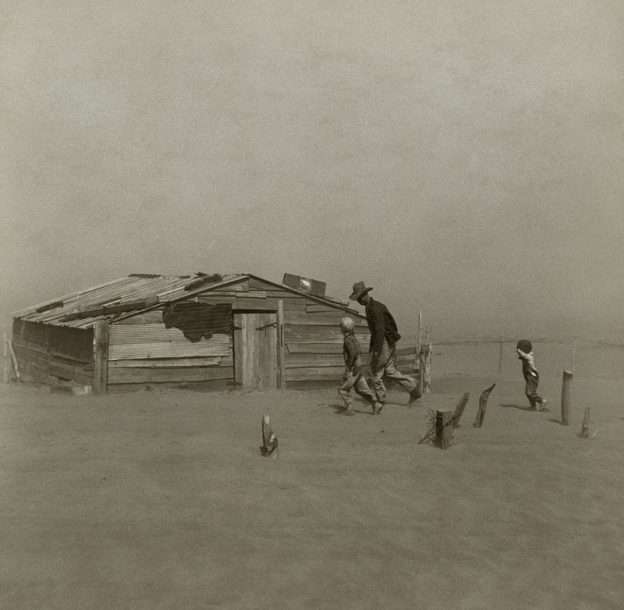
Farmer and sons in a dust storm, April, 1936. Cimarron County, Oklahoma. Photo: Arthur Rothstein.

“I’m too young to have been through the Dust Bowl, but both my parents went through it,” Dwight Abell said, as he gazed out over the broad sweep of grasslands on his western Kansas ranch. “And my grandparents of course lived through it, back in the ’30s.”

“It was a bad time for everybody, but [my grandparents] made it through,” Abell said. “They didn’t do a whole lot of farming—they had mostly grass and cows.”

Abell’s great grandparents came to western Kansas in the 1880s. In 1908, they bought land and built the home where Abell and his family now live.

Back in the late 1800s, native prairie grasslands still stretched unbroken across much of the southern Great Plains. Fires regularly swept through, and prairie grasses and forbs responded with an explosion of new growth, which drew hungry herds of bison, pronghorn, and elk. This dynamic duo of fire and grazing by large herbivores shaped a robust prairie community.

Equipped with farming backgrounds and Homestead Act requirements to ‘prove up’ on their 160-acre parcels, most settlers plowed the prairie’s grasslands under and planted crops, even in the southern Great Plains—the hottest, driest region of the Plains.

Map of region hardest hit by during the Dust Bowl, overlaid with the boundaries of current and historic lesser prairie-chicken range. Click map for enlarged view.

During the Dust Bowl decade of the 1930s, homesteaders in the southern plains encountered the formidable limitations of farming in a region of low rainfall, high winds, and frequent droughts.  The native prairie plant community is well adapted to withstand these conditions, but the tilled soil was not. When prolonged drought struck, millions of acres of bone-dry soils lay exposed to the winds that regularly scour this region.

Dust Bowl winds carried off an estimated 480 tons of topsoil per acre in the southern Great Plains. Thick dust hung in the air and settled in deep, rolling drifts that suffocated grasslands, livestock, and wildlife. Poverty and famine gripped the region.

This epic calamity awakened Americans to the importance of preventing soil erosion and prompted the formation of the Soil Erosion Service in 1933. Congress then created the Soil Conservation Service (SCS) in 1935 (later renamed the Natural Resources Conservation Service), to work one-on-one with landowners and help them adopt sustainable agricultural practices that prevent further soil erosion.

NRCS also dispatched a team of scientists to map the region’s diverse soils. These soil survey maps allowed NRCS field staff to tailor conservation practices to meet the particular soil conditions of each farm.

The soil maps also identified areas where the soil was particularly vulnerable to erosion and would benefit from restoration back to grasslands. This restoration practice took a big leap forward in 1985, which the USDA launched the Conservation Reserve Program (CRP) through the Farm Service Agency (FSA).

CRP offered farmers an alternative to planting fragile soils to crops. Instead, a farmer could receive an annual rent to plant marginal croplands back to grass and maintain them as grassland for 10-15 years. Through CRP, NRCS and FSA joined forces with local farming families and restored large areas of formerly cultivated lands back to prairie grassland.

Lesser prairie-chicken nest in CRP grassland, Kansas. Photo: Jeremy Roberts, Conservation Media.

It soon became apparent that, in addition to its intended goal of stabilizing soils, CRP also improved habitat for grassland-dependent wildlife. The southern plains region, epicenter of the Dust Bowl, is also the only place on Earth the lesser prairie-chicken inhabits. Once common on the southern Great Plains (scientists estimate a historic population of about one million), their numbers plummeted during the Dust Bowl era, and some thought the bird had gone extinct. They have rebounded somewhat since then, with a current population of about 33,000—a number still low enough to still leave the population highly vulnerable to further decline.

In encouraging recent studies, scientists have found that lesser prairie-chickens have reoccupied portions of their historical range by moving into former croplands now planted to CRP grasslands. What’s more, the birds have expanded beyond the bounds of their historical range in western Kansas by occupying newly created CRP grassland habitat (see map).

But scientists have found that, over time, the wildlife habitat values of restored and idled CRP acres declined, because these grasslands lacked the natural disturbances of large herbivore grazing and fire that historically sustained and revitalized them. Moreover, those CRP grasslands weren’t contributing to landowners’ agricultural operations, since the enrolled acreage had many limitations on mid-contract grazing.

Faced with the questions of how to improve habitat for at-risk wildlife and how to increase agricultural productivity on private agricultural operations, the USDA introduced the “Working Lands for Wildlife” concept, with the unprecedented proposition that strategically focused assistance to landowners could increase populations of at-risk wildlife while improving the sustainability of farms and ranches.

Male lesser prairie-chicken during springtime courtship display. Photo: David Haukos

The NRCS-led Lesser Prairie-Chicken Initiative (LPCI) is a perfect example of this. LPCI provides technical and financial assistance to landowners within the current range of the lesser prairie-chicken who voluntarily enhance lesser prairie-chicken habitat through conservation practices that also benefit their agricultural operations.

LPCI looks at habitat conservation for the lesser prairie-chicken from a landscape perspective, addressing key questions about their overall population dynamics. Where exactly do lesser prairie-chickens currently live, and what are the characteristics of that habitat? What obstacles are inhibiting population growth? Which conservation practices best address those issues? Where should we target these conservation practices to have the greatest return on investment?

While the answers to these questions continue to emerge through on-going research, some things are clear: Lesser prairie-chickens need expansive grassland habitat to survive, with diverse structure for nesting, brood rearing, hiding from predators, and sheltering from weather extremes.

Scientific studies and innovations help fine-tune LPCI’s outreach to landowners. Using detailed mapping of the extent and characteristics of the lesser prairie-chicken’s current range, LPCI identifies and focuses funding on the highest priority areas for conservation efforts—areas of core habitat and areas that have the potential for creating habitat corridors between those core areas.  With more than 95% of the lesser prairie-chicken’s habitat on private land, engaging private landowners in voluntary conservation practices is essential to the bird’s survival.

Helping ranchers transition their CRP acreage to grazing is one of LPCI’s core conservation strategies. Back in 2005, when Dwight Abell enrolled his land in CRP, he was clear about his management goal. “When we put this land into CRP,” he said, “I told them my intention was, when it comes out, to utilize it for grazing for cattle, and I wanted to use it to benefit the wildlife. I think there’s room for both responsible grazing and for wildlife like prairie-chickens.”

LPCI provides technical and financial assistance to landowners for voluntary conservation practices like prescribed grazing, woody plant removal, and prescribed fire. Photo: Stan Bradbury

Many ranchers share Abell’s vision. CRP currently enrolls more than 4.8 million acres of land within the lesser prairie-chicken’s range. But CRP acreage only offers habitat for prairie-chickens and other grassland wildlife as long as it remains grassland. Once a CRP contract expires, that grassland habitat can disappear if it’s more economically viable for the landowner to return the land to crops than to maintain the grassland for grazing.

The infrastructure needed to make the shift to grazing—perimeter fencing, water development, and such—can be prohibitively expensive for private landowners. LPCI helps landowners over that transitional hurdle by providing assistance with grazing management planning and grazing infrastructure, and by offering technical and financial support for forage- and habitat-boosting practices like prescribed fire.

“It’s a win-win for ranchers and chickens,” said Christian Hagen, science advisor to LPCI. “By helping ranchers transition what was once marginal cropland to grazing after CRP contracts expire, we’re helping to maintain viable habitat for the lesser prairie-chicken while supporting the sustainability of working lands and rural economies.”

Rancher Dwight Abell stands by his CRP fields, Kansas. Photo: Jeremy Roberts, Conservation Media

Abell agrees. “Raising cattle has made us more money every year than farming has—we’re able to keep more,” he said. “I’m 100% committed—I’m not going to tear this [grassland] out. It just works better for our operation to have cattle and grass.”

That economic viability allows for the family’s ranching legacy to continue into the next generation. “Our two boys have talked about wanting to do this too,” Abell said. “They like the lifestyle. They like seeing the cows, the grass—the benefits of living out here.”

From CRP to Grazing—Details on How to Make the Shift

When CRP acres near the end of their 10- to 15-year contract, a rancher can apply to enroll the acreage in another CRP program, like the CRP Grasslands program and the CRP State Acres for Wildlife Enhancement (SAFE) program. Each of these CRP programs has limitations—the CRP Grasslands program is aimed at livestock operations with fewer than 100 head of cattle and enrollment is capped at 200 acres. SAFE contracts only permit grazing one out of every three years over the life of the contract. The contracts for both programs run from 10 to 15 years.

Through LPCI, ranchers can access assistance for grazing planning, water development and other infrastructure, prescribed fire, and other conservation practices through three-year contracts with the NRCS Environmental Quality Incentives Program (EQIP). In some states, funding for perimeter fencing may also be available through EQIP.

Jordan Menge, LPCI Range Coordinator, notes that, for states within the Lesser Prairie-Chicken Initiative Action Area (portions of Texas, Oklahoma, Kansas, Colorado, and New Mexico), a certain amount of EQIP funding is set aside specifically for projects that benefit lesser prairie-chicken habitat.

“LPCI funds are available to those producers that are in a focal or connectivity zone within Lesser Prairie Chicken action area or there are known leks within a .5 mile of their property,” said Menge.

Landowners interested in taking part in and LPCI contract to help transition their CRP acreage to grazing should contact their local NRCS field office. A range conservationist can then visit one-on-one with the landowner and discuss assistance options available through the Lesser Prairie-Chicken Initiative.

What’s in it for My Operation?

LPCI funding helps ranchers bring expired CRP grasslands into grazing production. LPCI and NRCS field staff work one-on-one with ranchers to develop a grazing plan and identify conservation practices and infrastructure that will bring the greatest benefit to ranch operations and lesser prairie-chicken habitat.


The Lesser Prairie-Chicken Initiative, led by the USDA’s Natural Resources Conservation Service, is a partnership-based, science-driven effort that uses voluntary incentives to proactively conserve America’s western rangelands, wildlife, and rural way of life.

Texas Ranchers Gather for How-to on Wildlife-Friendly Grasslands

By Quenna Terry, NRCS Public Affairs Specialist

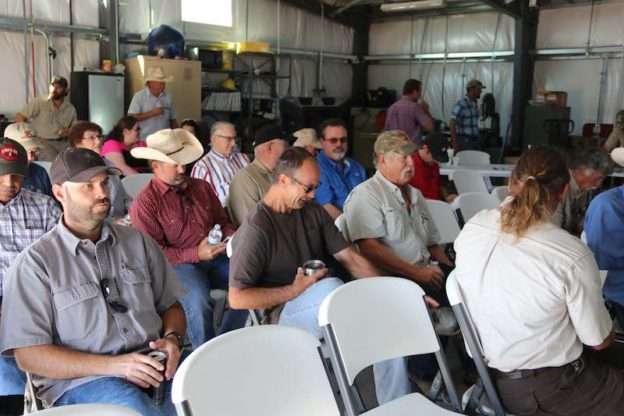
When farmers and ranchers take time out of their busy schedules to attend a meeting, you can bet the topic’s compelling. For more than 40 agricultural producers who gathered recently at Muleshoe National Wildlife Refuge in Texas, the day’s topic was managing rangelands to improve wildlife habitat.

More than 40 farmers and ranchers attended the Landowner Wildlife Workshop at the Muleshoe National Wildlife Refuge in Texas. Photo: Quenna Terry, USDA-NRCS

Jordan Menge, range coordinator for the Natural Resources Conservation Service-led Lesser Prairie-Chicken Initiative (LPCI), organized the workshop. His cast of presenters drew from the many agencies and organizations that share the goal of conserving native wildlife and rural agriculture, including the USDA Natural Resources Conservation Service (NRCS), Quail and Pheasants Forever, Blackwater Valley Soil and Water Conservation District (SWCD), U.S. Fish and Wildlife Service, and the Texas Parks and Wildlife Department.

Many of those organizations offer assistance to ranchers to carry out habitat conservation, and the presenters showed how the available programs help ranchers manage range to benefit both wildlife and livestock.

Dr. Blake Grisham from Texas Tech University opened the workshop by sharing the life history and management of the lesser prairie chicken, drawing from research from the panhandle region. Lesser prairie-chicken populations need large tracts of high-quality prairie to survive and reproduce. Biologists consider the lesser prairie-chicken to be an “umbrella species” for habitat conservation because when habitat is optimal for this bird, they benefit countless other members of the Southern Great Plains.

Grisham explained that research still hasn’t fully determined all of the factors contributing to lesser prairie-chicken population declines, but that studies show that habitat fragmentation plays a key role. The additional of vertical structures to the prairie landscape—both in the form of tree encroachment and built structures—adds to that fragmentation. Grisham noted that research will continue to inform our understanding of the most effective management practices for lesser prairie-chicken habitat.  He credited NRCS and its LPCI partnership for supporting his research.

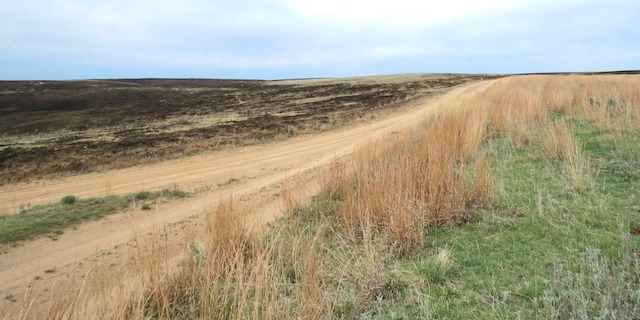
Prescribed fire is an important management tool for improving grasslands for bird and herd. Photo shoes recently burned grasslands at the Muleshoe National Wildlife Refuge. Photo: Quenna Terry, USA-NRCS

NRCS Range Management Specialist Stan Bradbury then shifted the conversation to the practice of prescribed grazing. He emphasized the importance of understanding plant growth, and discussed ways to provide nesting cover for prairie-chickens and other ground-nesting birds through grazing deferment.

Bradbury described how range managers can influence grassland habitat through their choice of where to locate water development, salt and minerals, and fences. Careful planning can help change the composition of plant communities and promote better grazing distribution and utilization.

Bradbury noted how grazing plans are tailored to the particular needs and characteristics of each ranch. “There isn’t a standard grazing system that works for everyone,” Bradbury said. He stressed that careful planning and preparation for drought is an essential part of grazing operations. “Drought plans need to be developed when it’s raining straight down.”

Jordan Menge described ways to improve quail habitat, stressing that, like prairie-chickens, both bobwhite and scaled quail do better in native grasses rather than monocultures. Richard Baker from the U.S. Fish and Wildlife Service rounded out the day with an introduction to prescribed burning as an effective tool for improving grassland health.

Jordan Menge, range coordinator for the NRCS-led Lesser Prairie-Chicken Initiative, organized the Landowner Wildlife Workshop and presented on improving quail habitat. Photo: Quenna Terry, USDA-NRCS

To accomplish grassland habitat improvements, landowners can take part in a variety of voluntary programs that offer technical and financial assistance. Since the array of programs can be confusing, representatives from each of the assistance agencies described the particular niche of their programs.

NRCS District Conservationist Angel Garcia described NRCS programs, like the Environmental Quality Improvement Program (EQIP) and Conservation Stewardship Program (CSP), which landowners can take part in to carry out prescribed grazing, drought planning, prescribed fire, woody plant removal, and other practices beneficial to wildlife habitat. For landowners within the active range of the lesser prairie-chicken, additional NRCS funds are available through LPCI.

Ryan Jones from the Western Association of Fish and Wildlife Agencies (WAFWA) discussed programs available through his organization, and Farm Service Agency Executive Director Mark Tucker shared information on the Conservation Reserve Program (CRP), Grassland Reserve Program (GRP) and State Acres for Wildlife Enhancement (SAFE).  Don Call of Texas Parks and Wildlife described the Texas Playa Conservation Initiative.

Farmer and rancher Jerry Don Glover, past chairman of the state FSA committee, attended the program.  Glover commented this was one of the best wildlife programs he had been to in a while, stating, “I came to the program because I’ve always been interested in how we can increase wildlife on our land, particularly for pheasant and quail.”

For more information about conservation assistance programs for improving wildlife habitat, contact your local NRCS office at the USDA Service center in your county.


The Lesser Prairie-Chicken Initiative, led by the USDA’s Natural Resources Conservation Service, is a partnership-based, science-driven effort that uses voluntary incentives to proactively conserve America’s western rangelands, wildlife, and rural way of life.