Author Archives: Greg Peters

Featured Friend: Western Association of Fish and Wildlife Agencies

Screen Shot 2016-07-10 at 10.54.55 PMMeet the Western Association of Fish and Wildlife Agencies, a key partner within the NRCS-led LPCI partnership. LPCI succeeds through the combined resources and know-how of many public agencies, nonprofit organizations, universities, and private businesses. LPCI partners expand the field delivery, science, and communications capacity for lesser prairie-chicken conservation.

Read/download the pdf of our Featured Friend, the Western Association of Fish and Wildlife Agencies.


One of LPCI’s core partners, the Western Association of Fish and Wildlife Agencies has taken an innovative and unprecedented approach to lesser prairie-chicken conservation. In partnership with the five states that are home to the lesser prairie-chicken, WAFWA created the Lesser Prairie-Chicken Range-wide Conservation Plan (RWP) to address the needs of this species while providing a mechanism for regional industry to continue operating.

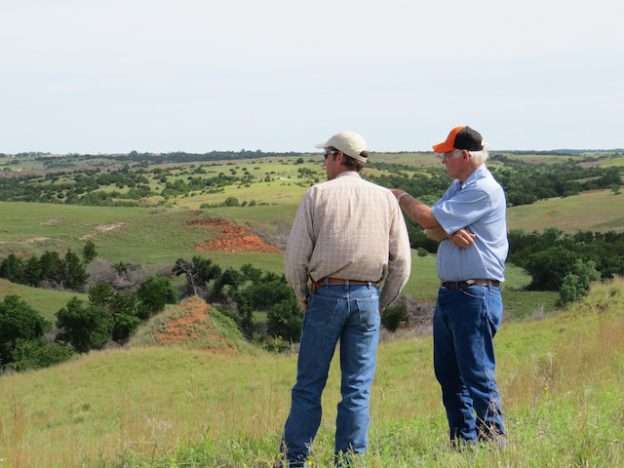
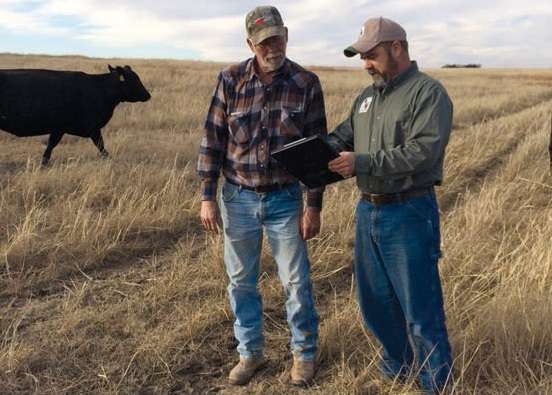
Brad Odle, right, is one of several WAFWA regional biologists who works with landowners to voluntarily manage rangelands for lesser prairie-chickens.

Brad Odle, right, is one of several WAFWA regional biologists who works with landowners to voluntarily manage rangelands for lesser prairie-chickens.

Completed in 2013, the plan established priority conservation areas, population goals, and habitat goals that all conservation partners are working towards. It also established a voluntary mitigation program for industries developing land within the lesser prairie chicken’s range. Mitigation fees support voluntary habitat conservation planning and management on private agricultural lands. The only plan of its kind endorsed by the US Fish and Wildlife Service, the RWP was incorporated into the Section 4(d) Special rule at the time of listing in 2014.

Meet WAFWA

About

Established in 1922, the Western Association of Fish and Wildlife Agencies represents 19 states and 4 Canadian provinces and supports sound resource management to conserve native wildlife. WAFWA’s lesser prairie-chicken work is part of a broad suite of wildlife conservation initiatives the organization carries out.

Role With LPCI

In addition to funding private land conservation practices, WAFWA provides funds for LPCI field staff who work one-on-one with agricultural producers and conducts monitoring to assess the success of conservation efforts, including an annual aerial population survey.

Contact

Jim Pitman, Lesser Prairie-Chicken Conservation Delivery Director, 620-208-6120, [email protected]

For more information: www.wafwa.org

Fire Helps Kansas Rancher Restore Redcedar-infested Grasslands

“When I was a kid growing up out here, there were no cedars. Dad would have to hunt like a dog for a cedar for a Christmas tree.” Tom Carr stands on a bluff overlooking the rolling grasslands of his thousand-acre ranch in the Gyp Hills of south-central Kansas, relishing the view. From this vantage point, it’s clear that you’d have to hunt like a dog once again to find a redcedar Christmas tree—a live one anyway—and that fact makes Tom grin from ear to ear.

Tom Carr (left) surveys the recovery of his ranch grasslands following the Anderson Creek wildfire, June 6, 2016.

Tom Carr (left) admires the recovery of his ranch grasslands ten weeks after the Anderson Creek wildfire with LPCI field staff member Ken Brunson (photo Sandra Murphy).

Though Tom was born and raised here, he spent his career as a professor at the University of Illinois. During that time, redcedars steadily spread across the ranch’s grasslands, as they have across much of this region in the absence of regularly occurring fire.

By 2004, Tom says, the cedars were everywhere. “My brother and I wanted to get it back to how we remembered it as kids, with hardly any cedars and grass to our waists.”

Tom remembers the abundant wildlife on the ranch at that time. “We had quail on quail,” he recalls. “We could pop up four covies in a half-hour.” All that disappeared, Tom says, when the redcedars took over.

Local ranchers Ted Alexander and Charles DeGeer told him about grant programs available for redcedar removal. “We’ve benefited a great deal from these government programs,” Tom says. With financial assistance, he was able to hire cutting teams to start to get a handle on the infestation.

Between 2005 and 2010, they cut cedars on about half the ranch’s grasslands. Despite the cutting, Tom says, cedars continued to spread because he hadn’t yet been able to conduct a prescribed burn.

He figured the burn would happen after he retired in 2010, when he and his wife Jo moved back to the Gyp Hills. But drought conditions set in and put the prescribed burn on hold.

In 2012 and 2013, Tom didn’t rent out the ranchlands for grazing as he usually does, to allow grass fuel to build up. Finally, in 2014, he was able to conduct his first prescribed burn on the ranch, as a member of the Gyp Hills Prescribed Burn Association. Over the course of two prescribed fires, he burned most of his grasslands.

Even so, many redcedars escaped unscathed. Determined to continue the grassland restoration process, he hired local rancher Keith Yearout in early 2016 to cut more redcedars in his west pasture.

Then, on the afternoon of March 23, 2016, the game-changing Anderson Creek Wildfire hit his ranch. “All hell broke loose,” Tom recalls. “It was an unbelievable day.” Stoked by high winds, low humidity, and highly flammable redcedars, the wildfire, which began a day earlier in northern Oklahoma, began to steamroll north.

Dense redcedar stands fuel the Anderson Creek wildfire, March 23, 2013 (Photo Dustin Carr).

“I had no idea there was a wildfire going on,” Tom says, recalling that day. “Then I got on Facebook and saw a post about a wildfire on the Comanche/Barber County line, four miles from my ranch.”

Tom and his son went to the ranch and pulled whatever farm equipment they could into his 120-acre tilled field. They watched the fire move onto their ranch from the west. Tom had just enough time to water around their equipment shed before the fire reached them, forcing them to retreat into the tilled field.

“It’s an interesting feeling to be completely surrounded by fire and flame,” Tom recalls with a grin. “We had 76 bales of hay pulled into the field, and they burned right up.”

The Anderson Creek wildfire races across Tom Carr’s ranch, while Tom and Dustin Carr take refuge in a tilled field. The 76 round hay bales shown in the video burned in the blaze, but the outbuilding survived (Video: Dustin Carr).

The fire burned so hot, it left nothing but bare, charred ground in its wake. “It was nothing like a prescribed burn,” Tom says. “It looked like an atomic bomb went off.”

Tom surveys the fire aftermath, which burned across his entire ranch.

Tom surveys the fire aftermath, which burned across his entire ranch (photo Dustin Carr).

The fire not only burned the ranch’s entire 880 acres of grasslands and scattered cedars, it also killed dense cedar stands on neighboring lands that would have remained a potent seed source for reinfestation.

“I was excited that so many redcedars were burning,” Tom says. He’s quick to preface his enthusiasm with empathy for the many losses experienced by people throughout the nearly 400,000-acre wildfire area. Some 600 cattle died in the fire, and several houses and outbuildings burned, along with many miles of fencing.

As current president of the Gyp Hills PBA, though, Tom is a big advocate for prescribed fire as a range management tool. “I hope the [wild]fire has convinced some people who weren’t sold on prescribed fire,” he says, since prescribed fire delivers the benefits of grassland rejuvenation and cedar control, but does so under carefully controlled conditions.

From Tom’s ranch, the rejuvenating power of fire is apparent as far as the eye can see. Beneath the blackened carcasses of thousands of redcedars and across wide-open fields, lush grasses and wildflowers—neon green in their vigor—cover what had been moonscape just 10 weeks earlier.

IMG_3389

By early June, grasses and wildflowers were flourishing on the ranch (photo Sandra Murphy).

“We had 18 prescribed burns lined up [within the Gyp Hills PBA],” Tom says with obvious satisfaction. “The fire took care of 14 of them!”

Tom’s equipment building survived the blaze, but he lost a lot of fence. Following the fire, he was amazed by and deeply grateful for the flood of volunteer labor and donated materials that helped with fence rebuilding.

The vigorous regrowth of grasses and forbs on his ranch allowed Tom to pasture cattle on his range in mid-June. He currently follows a prescribed grazing plan developed through the NRCS-led Lesser Prairie-Chicken Initiative (LPCI). Though his land doesn’t currently support prairie-chickens, it qualified for the LPCI assistance program because of its location in a targeted priority area within active lesser prairie-chicken range.

The plan identifies a stocking rate that aims for a “take half, leave half” forage utilization, which builds grassland health and drought resiliency. “And that’s great for the lesser prairie-chicken!” Tom says with a grin.

IMG_3392 copy

Catclaw sensitive briar, an indicator of healthy grasslands, was one of many wildflower species brightening the range just two months after the wildfire (photo Sandra Murphy).

It’s also good for myriad other grassland species, including the quail he and his brother hope to see restored. He’s excited about the future of his ranchlands, especially in the wake of the wildfire.

“The fire killed millions of cedars, and the land is changing for the good,” Tom says, sweeping his arm across the prairie expanse. “It doesn’t get much better than that.”

Learn more about LPCI’s technical and financial assistance opportunities for conservation planning, conducting prescribed burns, implementing prescribed grazing plans, and more by contacting your local NRCS office.

Latest Aerial Survey Documents Stable Lesser Prairie-Chicken Population Trends

The latest lesser prairie-chicken aerial survey shows bird population trends remain stable after five years of aerial survey data collection. Conducted by the Western Association of Fish and Wildlife Agencies (WAFWA), the surveys indicated an estimated breeding population of 25,261 birds this year which scientists say is not significantly different from the 29,162 birds estimated in 2015 given the variability in the survey methodology. This spring’s breeding population remains significantly larger than the 17,616 birds estimated in 2013 following two years of severe drought.

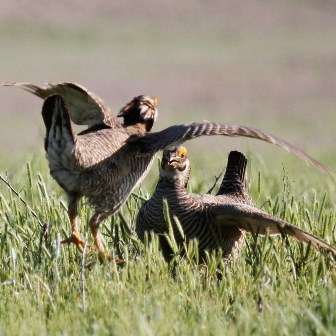
Lesser prairie-chickens on a lek in New Mexico. Nick Richter photo

Lesser prairie-chickens on a lek in New Mexico. Nick Richter photo

Lesser-prairie chickens inhabit four ecoregions in five states: Colorado, Kansas, New Mexico, Oklahoma and Texas.  Their numbers regularly fluctuate up and down from year to year due to changes in habitat conditions, mainly influenced by rainfall patterns. The surveys this year indicated apparent population increases in the shinnery oak ecoregion of eastern New Mexico and the Texas Panhandle and the sand sagebrush ecoregion of southeast Colorado and southwest Kansas.  Lesser prairie-chicken populations in these regions experienced the most decline as a result of the 2011-2012 drought.

Aerial surveys recorded population decreases in the mixed-grass prairie ecoregion of the northeast Panhandle of Texas, northwest Oklahoma and south-central Kansas, and the short-grass prairie region of northwest Kansas.

“Just as with last year’s population increase, we shouldn’t read too much into short-term fluctuations over one or two years,” said Bill Van Pelt, WAFWA grassland coordinator. “Lesser prairie-chickens inhabit a large geographic landscape with highly variable weather patterns, so we expect to see annual and regional population fluctuations.”

Van Pelt added that these numbers show the importance of maintaining good prairie habitat for long-term population stability. “Voluntary conservation efforts like the range-wide plan help to ensure that suitable habitat is available so these population increases can occur when weather conditions are suitable,” he said.

Brad Odle (right) is one of four WAFWA regional biologists working with private landowners to improve lesser prairie-chicken habitat.

Brad Odle (right) is one of four WAFWA regional biologists working with private landowners to improve lesser prairie-chicken habitat.

WAFWA oversees the Lesser Prairie-Chicken Range-wide Plan (RWP) in collaboration with state wildlife agencies of Texas, New Mexico, Oklahoma, Kansas and Colorado. The plan was developed to ensure long-term viability of the lesser prairie-chicken through voluntary cooperation by landowners and industry. Industry contributions support conservation actions implemented by participating private landowners. To date, industry partners have committed over $60 million in enrollment and mitigation fees to pay for conservation actions, and landowners across the range have agreed to conserve over 130,000 acres of habitat through the RWP’s 10-year and permanent conservation agreements.

WAFWA is a partner organization in the Lesser Prairie Chicken Initiative (LPCI), a conservation partnership launched by the Natural Resources Conservation Service in 2010. Since its inception, LPCI has enrolled more than 450 landowners in conservation agreements to improve grassland habitat on more than one million acres.

LPCI, WAFWA, and other partner organizations offer a range of voluntary technical and financial support to landowners to create habitat conditions that benefit lesser prairie-chickens and support long-term viability of agricultural operations.

“With continued improvement in nesting and brood-rearing habitat associated with good weather conditions and private landowner conservation actions, we are optimistic about the lesser prairie-chicken’s future,” said Alexa Sandoval, chairman of WAFWA’s Lesser Prairie-Chicken Initiative Council. “Habitat conservation and species recovery is a marathon, not a sprint. We appreciate the continued commitment of all of our partners in our ongoing conservation efforts.”

Passion for Wild Things–A Poet’s Perspective on WLFW Conservation

Ranch manager Martin Moore (right) proudly shows the redcedar removal work he has done on the Moore Ranch to NRCS District Conservationist Paul Clark

Ranch manager Martin Moore (right) and NRCS District Conservationist Paul Clark savor the view of redcedar removal work on the Moore ranch in Oklahoma.

There’s a lot of science and strategy behind what the Lesser Prairie-Chicken Initiative does within the NRCS Working Lands For Wildlife partnership. But those efforts are fueled and made successful by the love and caring that landowners and the resource managers who work with them feel for the land. A poem by  Ritch Nelson, NRCS Nebraska State Wildlife Biologist beautifully captures this conservation spirit.

Wild Things 

A wise man named Aldo, once wrote of ‘wild things’
The chance to find a pasque flower; chart when a bird sings.

The delight these things offer to enrich our lives.
The harmony of nature for which man strives.

He joined up with Bennet on Wisconsin’s small farms,
For good soil and water, to keep critters from harm.

T’was back in the thirties but the concept lives on.
Conserve the resource before it is gone.

Degraded landscapes are taking a toll.
Private landowners play a critical role.

Much wildlife lives on our working lands.
We can save these key species if we all lend a hand.

The chickens that range ‘cross the southern High Plains;
Where ranchers and partners are taking great pains,

To restore the grassland and supply more fodder.
Nest success up; prescribed fires burn hotter.

While in the southeast, down under the pines,
Plans for the tortoise are making headlines.

For they offer many a critter a home,
In burrows dug deep in the sandy loam.

The outlook now better for a small, lowly toad.
When we partner together and take a new road.

Out west in the spring a large bird is booming,
And meanwhile threats to its life-blood are looming.

But livestock and grouse can be on the same page;
Persist side by side in a vast sea of sage.

Throughout Appalachia, a warbler calls out –
Counted in data, the biologists tout.

In southwest Montana a new day now dawns;
Streams clear and free-flowing where the grayling will spawn.

The bunny fares better with succession set back;
With the woodcock and ruffed grouse also on track.

The Oregon chub, a small fish – delisted;
Thriving in floodplains with oxbows so twisted.

Big rivers that flow through the land of the bear,
Support wooded swamps on lands we now share.

And with each new cub, the black bear secures
A more solid footing, their future endures.

All that is done, the efforts we take,
Is for the whole sum, not just for the sake,

Of one target species but rather the web;
The cogs on a wheel, as time flows and ebbs.

There’ll always be more ‘wild things’ to conserve;
To be more proactive and not just observe.

Rural communities of neighbors and friends,
Are much more complex for they do extend,

To soil and water, plants, animals, air –
The whole ecosystem for which we care.

For shouldn’t we love, admire and respect?
To build a land ethic to help us connect,
The humans to resources, we dare not neglect.

Pulling together, we now take a stand
To follow our calling, helping people help the land!

New Magazine Highlights Conservation Successes on Working Lands, Including LPCI

From ranchers in the West to forest managers in the East, private landowners are voluntarily conserving habitat for wildlife, helping species rebound and recover. These successes—including the Lesser Prairie-Chicken Initiative’s work conserving grassland habitat in the southern Great Plains—are the focus of the new Working Lands for Wildlife (WLFW) magazine.

Read the magazine.WLFWmagazine

WLFW is a Natural Resources Conservation Service (NRCS) partnership initiative that targets species whose decline can be reversed and benefits other species with similar habitat needs. Species include the lesser prairie-chicken, New England cottontail, Southwestern willow flycatcher, greater sage-grouse, gopher tortoise, bog turtle and golden-winged warbler.

Private lands are essential for providing habitat for nearly two-thirds of all species listed as threatened or endangered under the Endangered Species Act (ESA). Through WLFW, NRCS works with conservation partners and private landowners to restore populations of declining wildlife species, provide regulatory certainty and strengthen and sustain rural economies. The nation’s landowners—farmers, ranchers and forest managers—provide not only food and fiber for the world but also include a variety of environmental benefits, including habitat for wildlife.

WLFW uses a voluntary, innovative approach to benefit high-priority habitat for seven species of wildlife that are declining, candidates for listing or listed under the Endangered Species Act (ESA).  WLFW works with agricultural producers to create and improve wildlife habitat with regulatory predictability from the U.S. Fish and Wildlife Service.


Permanent Protection for Prairie-Chicken Habitat in Kansas

The Western Association of Fish and Wildlife Agencies (WAFWA) has finalized the purchase of approximately 30,000 acres of high-quality lesser prairie-chicken habitat in southwest Kansas. The permanent protection and long-term conservation of lesser prairie-chicken habitat is an important goal of the Lesser Prairie-Chicken Range-wide Conservation Plan. Funding for this acquisition comes from the voluntary contributions of industry partners that are enrolled in the range-wide plan.

0297(David Haukos) copy

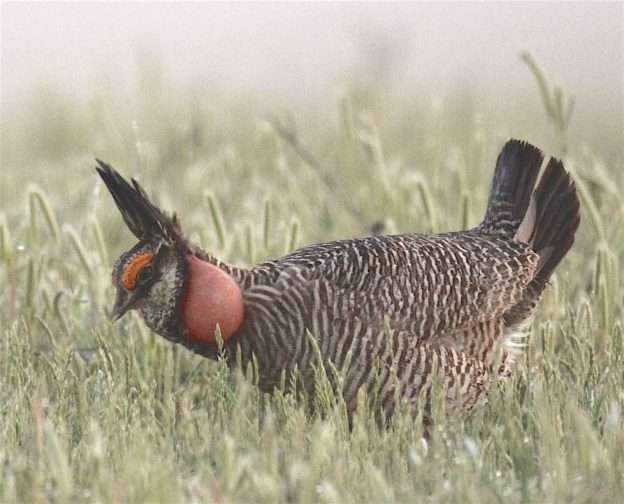
Lesser prairie-chicken male during courtship display (photo: David Haukos)

“The acquisition of Sunview Ranch is a significant positive development to conserve the lesser prairie-chicken,” said Alexa Sandoval, Director of the New Mexico Department of Game and Fish and Chairman of the Lesser Prairie-Chicken Initiative Council.

“This transaction involved a willing seller of land that contains prime lesser-prairie chicken habitat and furthers our goal of providing a stronghold of at least 25,000 acres in each of the ecoregions where the lesser prairie-chicken is still found. We commend all of our partners for their continued commitment to conservation of the lesser prairie-chicken,” Sandoval said.

The range-wide plan is a collaborative effort of WAFWA and the state wildlife agencies of Kansas, Colorado, New Mexico, Oklahoma and Texas. It was developed to ensure conservation of the lesser prairie-chicken through voluntary cooperation by landowners and industry. The plan allows agriculture producers and industry to continue operations while reducing impacts to the bird and its grassland habitat.

The Sunview Ranch (formerly Tate Ranch) is in the sand sagebrush ecoregion, which covers portions of Kansas, Colorado and Oklahoma and once contained the highest density of lesser prairie-chickens in the country. The dominant vegetation on rangelands in the region is sand sagebrush which is a native shrub typically associated with deep sandy soils in dune landscapes. Livestock grazing is the primary land use on rangeland throughout the sand sagebrush region, and through grazing leases, will continue to be used as a management tool on the Sunview Ranch.

“This property is one of the largest remaining contiguous tracts of sand sagebrush prairie in the region,” said Jim Pitman, Conservation Delivery Director for WAFWA. “Conserving this property in perpetuity ensures that it will remain a working ranch and continue to provide habitat for the lesser prairie-chicken in the portion of its range where the population has declined the most.  Prescribed grazing is the core management practice for lesser prairie-chickens, and we will be implementing it on the ranch to conserve and enhance habitat for the species.”

Western Livestock Journal Showcases LPCI Strategy

LPCI’s new Conservation Strategy takes centerstage in the 

The story, Good for the Bird, Good for the Herd, by WLJ Managing Editor Kevin Halladay, begins this way:

In what seems to be a welcomed proliferation of private partnership efforts, a new strategy to improve habitat for the lesser prairiechicken focuses on what ranchers have been saying for decades; grazing required!

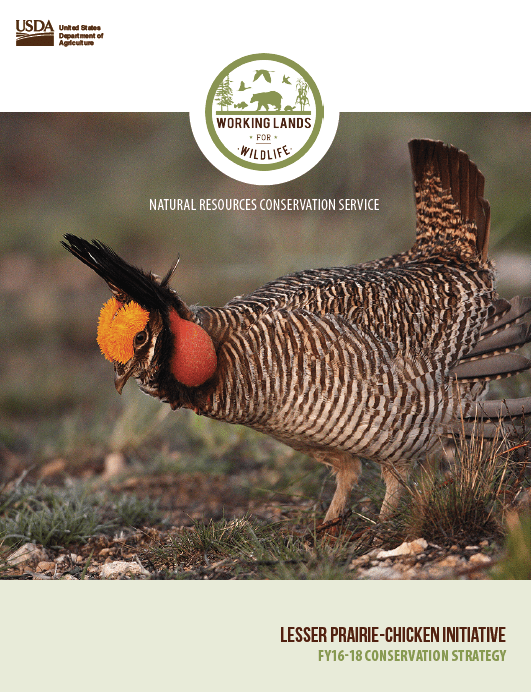
0302(David Haukos),webUSDA’s Natural Resources Conservation Service (NRCS) released a three-year conservation strategy for the lesser prairie-chicken at the end of April. Noting that the bird’s habitat is located almost exclusively on privately-held lands, the emphasis on partnering with landowners in ways that are mutually beneficial was strong.

“About 95 percent of the lesser prairie-chicken range falls on private lands, making conservation efforts on these productive family farms and ranges pivotal to the lesser prairie-chicken’s success,” wrote Jason Weller, NRCS Chief, in the plan’s introduction.

“Conservation efforts are designed to be win-win, benefitting the bird while improving the long-term sustainability of agricultural operations. New research demonstrates that sustainable grazing and lesser prairie-chicken conservation are not only compatible, but interdependent.”

The strategy seeks to involve an additional 500,000 acres of private land in the bird’s habitat to add to the roughly 1 million acres already involved in voluntary conservation efforts. The scope of this goal extends out to 2018 when the current farm bill expires. Generally speaking, strategies revolve around improving grassland health through prescribed grazing and judicious use of fire as management tools, and the removal of invasive woody plants.

“Across the country, we’re seeing firsthand how farmers, ranchers and forest landowners are voluntarily stepping forward to aid wildlife species,” Weller added in the group’s announcement of the plan.

“By adopting conservation systems, agricultural producers in the southern Great Plains can restore top-notch lesser prairiechicken habitat while also making working lands more productive and resilient to wildfire and climatic extremes.”

USDA Unveils Three-Year Conservation Strategy for Lesser Prairie-Chicken

WILMORE, Kansas, April 28, 2015 – USDA today announced the release of a three-year conservation strategy that will guide the voluntary restoration of 500,000 acres of habitat for the lesser prairie-chicken, an iconic grassland bird of the southern Great Plains. The bird has historically suffered from population declines, and this strategy is part of an ongoing science-based strategic effort by USDA’s Natural Resources Conservation Service (NRCS) to restore grassland and prairie ecosystems while enhancing grazing lands in five states.

LPCIFY16-18ConservationStrategyCover“Across the country, we’re seeing firsthand how farmers, ranchers and forest landowners are voluntarily stepping forward to aid wildlife species,” NRCS Chief Jason Weller said. “By adopting conservation systems, agricultural producers in the southern Great Plains can restore top-notch lesser prairie-chicken habitat while also making working lands more productive and resilient to wildfire and climatic extremes.”

NRCS Assistant Chief Kirk Hanlin made the announcement today at Hashknife Ranch where the Koger family has worked to conserve habitat through the Lesser Prairie-Chicken Initiative (LPCI), part of the agency’s Working Lands for Wildlife (WLFW) partnership. Since 2010, LPCI has conserved more than 1 million acres of high-quality habitat in Texas, Oklahoma, Kansas, New Mexico and Colorado.

By the end of 2018, this science-based strategy will guide the restoration of another half-million acres by focusing on five key threats to the bird—degraded rangeland health, invasive redcedar trees and mesquite, cultivation of grazing lands and lack of fire in grassland habitats.

Download the Strategy.

Conservation efforts on the Hashknife Ranch (above) and on other private agricultural lands throughout the lesser prairie-chicken range make working rangelands more productive and resilient to wildfire and climatic extremes.

Conservation efforts on the Hashknife Ranch (above) and on other private agricultural lands throughout the lesser prairie-chicken range make working rangelands more productive and resilient to wildfire and climatic extremes.

This strategy also aligns with ongoing efforts of the Western Association of Fish and Wildlife Agencies and other conservation partners throughout the lesser prairie-chicken range.


Research and experience gained through ongoing conservation efforts guide the focus for restoring and protecting lesser prairie-chicken habitat. For example, a recent study found the birds avoid redcedar trees by placing their nests at least 1,000 feet from the nearest tree, and that they stop using grasslands altogether when tree density reaches three trees per acre.

The prairie and grassland ecosystems of the southern Great Plains evolved through the interaction of fire and grazing large animals such as bison. By introducing fire and sustainable ranching practices and removing invasive woody species, ranchers are mimicking historic conditions on Great Plains ecosystems and improving habitat for lesser prairie-chickens while at the same time minimizing risks of catastrophic wildfires.

With about 95 percent of the lesser prairie-chicken’s range under private ownership, voluntary conservation is key to benefitting the species and its habitat. The bird is no longer listed as a threatened species under the Endangered Species Act after a court vacated the March 2014 designation by the U.S. Fish and Wildlife Service (FWS).

Lesser prairie-chicken male displays on a lek (display ground) in eastern New Mexico that burned just a few days earlier.

Lesser prairie-chicken male displays on a lek (display ground) in eastern New Mexico that burned just a few days earlier.

“NRCS remains firmly committed to promoting and delivering long-term conservation of the working grassland ecosystems that the species requires,” Weller said. “In this report, we lay out our renewed commitment to this partnership through 2018, the life of the Farm Bill, and demonstrate the effectiveness these investments can have in bringing back lesser prairie-chicken populations while improving agricultural operations.”

NRCS provides technical and financial assistance to ranchers who want to adopt conservation systems that address threats to and conserve lesser prairie-chicken habitat. To learn more about assistance opportunities, ranchers should contact their local USDA service center.

Habitat restoration efforts on private lands are helping species recover across the country. Earlier this year, the FWS delisted the Louisiana black bear because of the species’ recovery on bottomland hardwood forests restored by Louisiana landowners. In 2015, the FWS determined listings were not needed for the greater sage-grouse, Bi-State sage-grouse and New England cottontail largely because of large-scale collaborative conservation efforts on private lands.

LPCI seeks qualified vendors for filmmaking project

Lesser Prairie-Chicken Initiative partner organization Pheasants Forever, Inc. seeks proposals from qualified vendors to create a multi-media outreach package including 1) 3 short films, 2) a photographic collection, and 3) a media-ready archive of b-roll footage in the South Great Plains area.

Download the Request for Proposals for full specifications.

All inquiries regarding quote submission are due by May 5th and may be directed to Sandra Murphy at 928-255-3111 or [email protected]. This work is supported by the Natural Resources Conservation Service, U.S. Department of Agriculture, under number 68-3A75-14-120.


New Study Measures Fire Impacts on Wildlife, Livestock in NM

When members of the Bureau of Land Management’s Pecos District fire team put on their fire gear, it’s almost always to fight a fire. In early March, though, they were starting fires, and they did a picture-perfect job of it.

“This region used to see fire on a six- to ten-year cycle,” said Scott Carleton, an ecologist with the United States Geological Survey’s New Mexico Cooperative Fish & Wildlife Research Unit at New Mexico State University (NMSU). “This is a fire-adapted community, with a species assemblage that evolved with fire.”

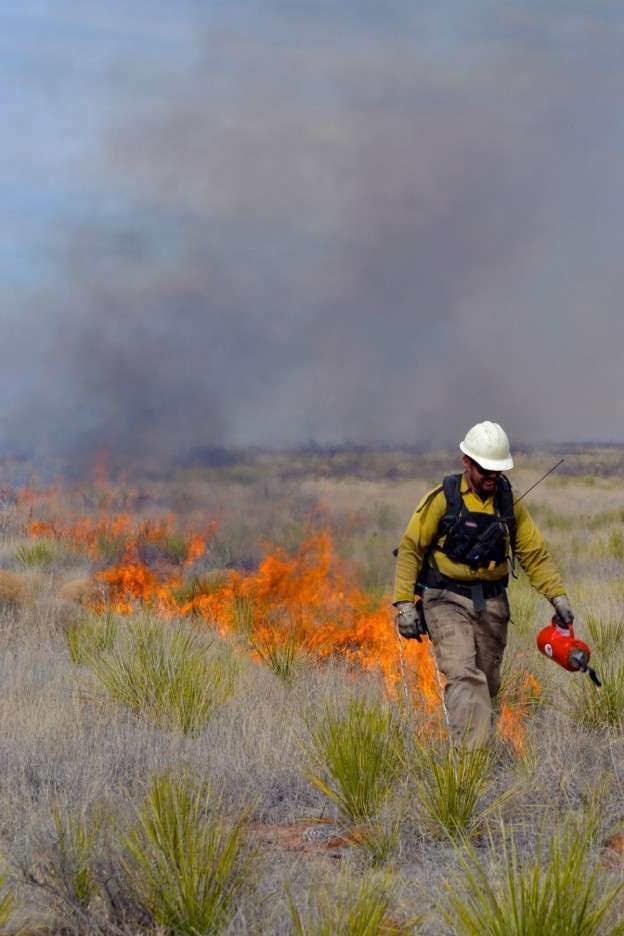
Member of the fire team lights a backburn on the BLM Sand Ranch ACEC (photo courtesy Scott Carleton).

Member of the fire team lights a backburn on the BLM Sand Ranch ACEC (photo courtesy Scott Carleton).

Carleton is part of a research effort to assess the effects of prescribed fire on lesser prairie-chickens at Sand Ranch, a 58,600-acre federally owned parcel 35 miles east of Roswell managed by the Bureau of Land Management (BLM).

Designated as an Area of Critical Environmental Concern, Sand Ranch is specifically managed as habitat for the lesser prairie-chicken, a species of grouse whose range and population numbers have declined dramatically as a result of many factors, including row-crop agriculture and fire suppression. In 2015, their total range-wide numbers were estimated at 29,000.

Sand Ranch is the only parcel within the lesser prairie-chicken’s five-state range that meets the US Fish and Wildlife Service criteria for a habitat “stronghold” for this uncommon grouse of the Southern Great Plains. A stronghold provides long-term protection to at least 25,000 acres of high-quality habitat for lesser prairie-chickens.

Before settlement, regularly occurring fires and periodic, intensive grazing by large herbivores shaped the Great Plains. BLM wildlife biologist Randy Howard notes that the prescribed fire treatment is part of a carefully planned effort to reintroduce these historic disturbance patterns on Sand Ranch.

“We’ve got this big chunk of real estate set aside for [lesser prairie] chickens,” Howard explained. “Instead of just throwing fire and grazing at it, we’re doing it carefully, and hoping that, as a result, we’re going to know the management path forward that’s best for the chicken.”

On March 4, they took a big first step, carrying out the first-ever prescribed burn on the parcel. The BLM fire team burned two management units totaling 3,100 acres. The results were exactly what Carleton and Howard had hoped for.

The prescribed fire snaked through the prairie, burning some areas, leaving other areas untouched or very lightly burned.

The prescribed fire snaked through the prairie, burning some areas, leaving other areas untouched or very lightly burned.

“We got a beautiful mosaic burn,” said Carleton. “I couldn’t have asked for better. The fire snaked through the prairie, with areas that didn’t burn and areas that did. We had chickens out foraging in it, right after the burn, and within two weeks we had a lek move from an adjoining unburned area to the recently burned area.”

Over the next three years, the BLM plans to burn the rest of the central part of the ranch, which is bracketed by roads that serve as fire breaks. By burning portions of the ranch each year, they’ll help create the varied habitat structure that lesser prairie-chickens need throughout the year.

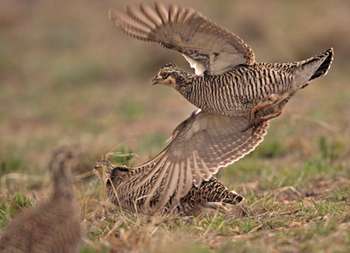
During mating season lesser prairie-chickens gather on leks, also called booming grounds, where males display and spar as they vie to mate with females. Leks generally form at sites with low vegetation, where males are most visible to one another and to females. For nesting, the females seek out the shelter of sites with taller, denser grasses and low prairie shrubs. When chicks hatch, females guide them to less dense vegetation, where the chicks can forage more easily but still have good hiding cover. Burning small portions of the ranch each year will help create this habitat mosaic.

A male lesser prairie-chicken displays at the BLM Sand Ranch prescribed burn site just a few days after the fire.

A male lesser prairie-chicken displays at the BLM Sand Ranch prescribed burn site just a few days after the fire.

The lesser prairie-chicken is what’s referred to as an umbrella species. Because the prairie chickens need large tracts of healthy prairie habitat to survive and reproduce, conserving habitat for them benefits many other prairie species as well.

During the prescribed burn, Carleton said, they watched Cooper’s and Swainson’s hawks circling at the head of the fire, hunting for small animals. Since then, they’ve seen plenty of wildlife on the burned acreage, including pronghorn and scaled quail.

Historically, fire and grazing acted in tandem to shape the prairie. Fire fingered across the grasslands, and the burned grasses resprouted vigorously in its wake. The fresh growth attracted herds of bison. Their grazing kept the fuel load low, ensuring that the next fire would burn the older, denser growth. And so the cycle went.

The BLM management study on Sand Ranch is carefully planned to fully explore how fire, grazing, and prairie habitat interact. Carleton describes how the six-year study will build from what he and his graduate students have already learned about Sand Ranch from studies over the past three years. “We know where they’re nesting, where they’re moving their broods, and where they are the rest of the year,” he says.

“Now we’re going to study how the birds’ movements change in response to fire,” Carleton continued. “At the end of three years, we’ll begin to implement grazing, but we’ll start with fire alone, so we can tease out the effects of each management practice.”

Howard notes that the research team will also assess whether increased grassland vigor from fire affects the quantity and quality of forage for livestock.

“If we do find that prescribed fire is beneficial to chickens,” Howard said, “we have to figure out a way to make it work for ranchers. We need to know, do the cows benefit?”

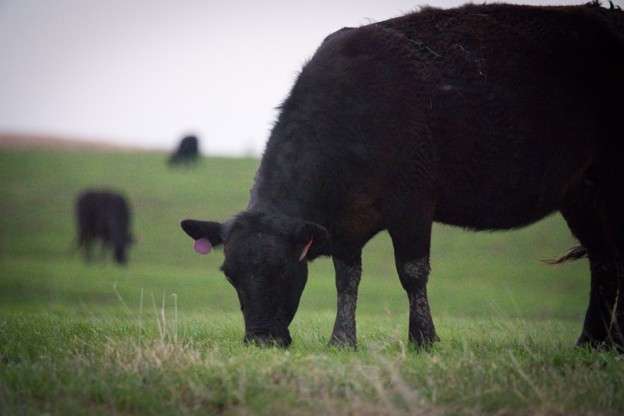
Cattle graze on recently burned prairie grassland in Kansas (photo: Jeremy Roberts, Conservation Media).

Cattle graze on recently burned prairie grassland in Kansas (photo: Jeremy Roberts, Conservation Media).

With 95 percent of the lesser prairie-chicken’s range on private land, conservation efforts hinge on engaging private landowners in habitat conservation practices that also improve ranch sustainability.

Studies over the past 50 years on the effects of fire on livestock forage in other parts of the country have shown that prescribed fire improves the palatability, nutritive value, and abundance of herbaceous plants and results in greater cow and calf weight gains. The Sand Ranch study will put that question to the test on New Mexico’s grasslands.

The BLM and NMSU are two of more than 25 organizations collaborating in a range-wide conservation partnership led by the Natural Resources Conservation Service, known as the Lesser Prairie-Chicken Initiative (LPCI).

LPCI provides financial and technical assistance to help private landowners voluntarily improve lesser prairie-chicken habitat. Working through Pheasants Forever, another partner organization, LPCI is helping to fund the six-year study, along with the BLM, USFWS, and New Mexico Department of Game and Fish.

“This study will help us quantify the impact of fire and grazing on lesser prairie-chickens in the shinnery-oak ecoregion,” said LPCI Science Advisor Christian Hagen. “What’s more, it will serve as a model for applying prescribed burns to private land, in a region where it’s not an established part of the range management toolbox.”