Good news for lesser prairie-chickens from LPCI partner organization, the Western Association of Fish and Wildlife Agencies (WAFWA):
The Western Association of Fish and Wildlife Agencies (WAFWA) recently submitted to the U.S. Fish and Wildlife Service (USFWS) its first annual report detailing achievements under the Lesser Prairie-Chicken (LPC) Range-wide Conservation Plan (RWP). Among other highlights, the estimated lesser prairie-chicken range-wide population increased by 20 percent to around 22,400 birds, industry partners committed $45.9 million in fees to pay for mitigation actions, and landowners across the range agreed to conserve nearly 40,000 acres of habitat.
Read the annual report here.
 “The results from the first year of RWP implementation clearly demonstrate that both industry and landowners are willing to conserve the species,” said Bill Van Pelt, WAFWA’s grassland coordinator.
“Private industry’s willingness to avoid and minimize impacts to lesser prairie-chickens is evident,” Van Pelt adds. “Where impacts were unavoidable, they paid mitigation fees to offset those impacts on cooperating landowners’ properties. As a result, all industry impacts were offset with conservation agreements during this first year.”
A key RWP goal is to engage private landowners in habitat conservation, since farmers and ranchers control much of the land within the bird’s estimated 40 million acre range in the states of Texas, Oklahoma, Kansas, New Mexico and Colorado. The annual report notes six landowner contracts were finalized during the reporting period March 1, 2014-February 28, 2015. WAFWA paid out $117,357 in signup incentives to landowners for enrolling 37,767 acres of lesser prairie-chicken habitat and anticipates paying landowners another $5 million for conservation practices over 10 years pending annual maintenance reviews.
Another key component of the RWP is cooperation of energy companies and other industry sectors operating within the bird’s range. During the first year, 174 oil and gas, pipeline, electric, wind energy, and telecommunication companies enrolled in agreements with WAFWA to avoid, minimize, or mitigate their operations. In the process they committed $45,877,823 in enrollment and impact fees to cover off-site mitigation actions for unavoidable impacts.
Significantly, the amount of habitat impacted by industry development decreased 23 percent, primarily due to a consolidation of oil and gas developments under the RWP. About 700 project agreements were authorized to offset impacts to lesser prairie-chickens from various development activities. This means companies were actively selecting areas that already had prior development for new project siting or actively selecting areas of lower quality habitat, and in doing so minimized the impact of their operations on lesser prairie-chickens and their habitat.
In addition to RWP achievements, the Lesser Prairie-Chicken Initiative (LPCI), a complementary program administered by USDA’s Natural Resources Conservation Service (NRCS), approved 23 projects across the species’ range in 2014 that will improve more than 180,000 acres of LPC habitat on privately-owned land through prescribed grazing and brush management. Through the LPCI program, landowners will be paid $2,935,894 for implementing conservation activities benefiting LPCs.
Through LPCI and the RWP, nearly a quarter million acres have been targeted for LPC conservation in the first year of RWP implementation.
“WAFWA has made tremendous strides in implementing the RWP during this first year, and is on target to accomplish their 10-year goals as outlined in the RWP and endorsed by the USFWS 18 months ago,” said Ross Melinchuk, Lesser Prairie-Chicken Initiative Council chairman.
He adds, “The Endangered Species Act and accompanying 4(d) rule, together with the RWP, provide a blueprint for conservation of this species. Given time, improvements in habitat, and the return of more favorable weather conditions across the species’ range, we should see a continued increase in lesser prairie-chicken populations across the range in the coming years.”


 “The results from the first year of RWP implementation clearly demonstrate that both industry and landowners are willing to conserve the species,” said Bill Van Pelt, WAFWA’s grassland coordinator.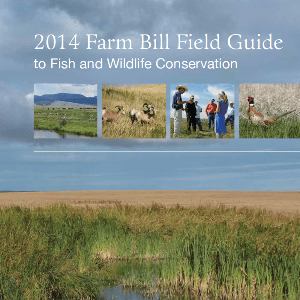
 April 28, 2015 – Today, the North American Bird Conservation Initiative released the 2014 Farm Bill Field Guide to Fish and Wildlife Conservation. This field guide is a tool to assist the staff of federal and state fish and wildlife agencies, nongovernmental conservation organizations, joint ventures, and other conservation partners in implementing Farm Bill conservation programs. It is primarily designed for those who work collaboratively with private landowners and agricultural producers to improve soil health, water quality, as well as fish and wildlife habitat.
 This user-friendly guide provides an overview of the Conservation Title in the 2014 Farm Bill, as well as Farm Bill history, program delivery, the role of partnerships, and priority setting. The guide includes case studies and details on the following programs: the Conservation Reserve Program, Agricultural Conservation Easement Program, Environmental Quality Incentives Program, Conservation Innovation Grants, Conservation Stewardship Program, Healthy Forests Reserve Program, Regional Conservation Partnership Program, and Voluntary Public Access and Habitat Incentive Program.
 This guide serves as an introduction for fish and wildlife conservation providers – the on-the-ground biologists, range conservationists, foresters, and others – who help deliver Farm Bill conservation programs to landowners. It is a tool to help them navigate the Farm Bill and its programs by engaging with landowners to conserve fish and wildlife habitat.