
by Sandra Murphy, LPCI communications specialist
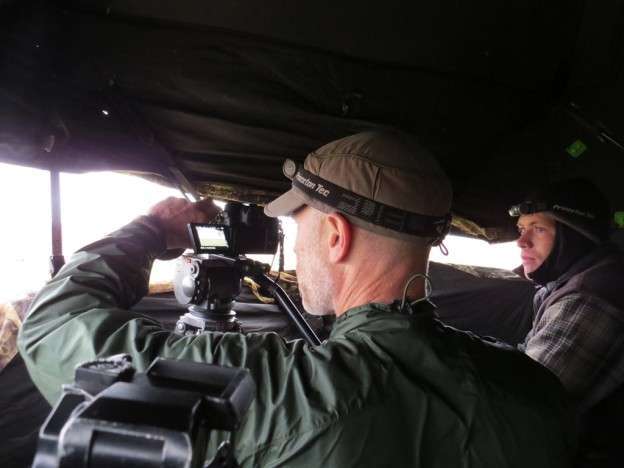
A steady wind blew from the north over the darkened prairie as Jonathan Lautenbach shook open a pop-up viewing blind on the Hashknife Ranch in southwest Kansas. He secured the blind with rebar stakes while filmmaker Jeremy Roberts ducked through the blind’s small opening, hauling boxes of equipment.

Jeremy Roberts (left) and Jonathan Lautenbach.
Jeremy set up his cameras by the light of his headlamp, preparing to film lesser prairie-chickens during their courtship displays. He’s in the midst of working with the Lesser Prairie-Chicken Initiative (LPCI) to develop short videos that show how ranchers and LPCI collaborate to achieve habitat conservation that benefits both the prairie-chicken and ranch sustainability.
Over the course of three days in April, Jeremy filmed some of the many ranchers whose land management efforts form the cornerstone of LPCI’s collaborative habitat conservation. In this round of filming, he focused on the practice of prescribe burning, a key tool in restoring grasslands.

Ed Koger lighting prescribed burn.
In the process, he talked with and filmed ranchers like Ed Koger of the Hashknife Ranch, whose patch-burn grazing practices mimic historic ecosystem dynamics on the prairie grasslands he manages. And Bill Barby, who spoke with Jeremy while standing in a pasture on his ranch where head-high grasses thrive in the wake of prescribed fire.

Lisa Ballout and Nathan Lee during prescribed burn conducted by members of the Red Hills Prescribed Burn Association.
Jeremy also captured on film the collaboration of some 50 members of the Red Hills Prescribed Burn Association. As they do regularly when conditions allow, these ranchers were helping one another with the labor-intensive practice of carefully burning grasslands on a member’s ranch.
As the first hints of light illuminated the hilltop lek (lesser prairie-chicken mating display site) where Jeremy and Jonathan hunkered in their viewing blind, the stars of the show—the whole reason LPCI exists and assists ranchers in carrying out their exemplary range management—arrived in a flurry of wingbeats and chortles. Nine male lesser prairie-chickens swept in from the surrounding prairie to dance and spar, vying for the attention of a handful of females who surveyed their mating prospects.
 Jeremy filmed their dance, the continuance of a springtime ritual that this species has enacted for thousands of years on the Southern Great Plains. He filmed, too, the efforts of Jonathan and his research assistants, who are studying the birds in an effort to better understand their needs and their responses to range management.
Cameras in hand, Jeremy will return Kansas in late May to film another aspect of LPCI collaborative work with ranchers—providing technical assistance for the Conservation Reserve Program. Stay tuned for updates on the filming process!
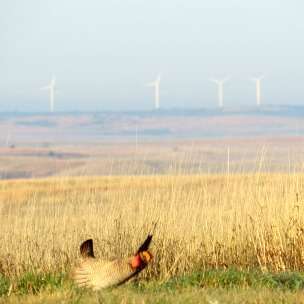
 “The results from the first year of RWP implementation clearly demonstrate that both industry and landowners are willing to conserve the species,” said Bill Van Pelt, WAFWA’s grassland coordinator.
 April 28, 2015 – Today, the North American Bird Conservation Initiative released the 2014 Farm Bill Field Guide to Fish and Wildlife Conservation. This field guide is a tool to assist the staff of federal and state fish and wildlife agencies, nongovernmental conservation organizations, joint ventures, and other conservation partners in implementing Farm Bill conservation programs. It is primarily designed for those who work collaboratively with private landowners and agricultural producers to improve soil health, water quality, as well as fish and wildlife habitat.
 This user-friendly guide provides an overview of the Conservation Title in the 2014 Farm Bill, as well as Farm Bill history, program delivery, the role of partnerships, and priority setting. The guide includes case studies and details on the following programs: the Conservation Reserve Program, Agricultural Conservation Easement Program, Environmental Quality Incentives Program, Conservation Innovation Grants, Conservation Stewardship Program, Healthy Forests Reserve Program, Regional Conservation Partnership Program, and Voluntary Public Access and Habitat Incentive Program.
 This guide serves as an introduction for fish and wildlife conservation providers – the on-the-ground biologists, range conservationists, foresters, and others – who help deliver Farm Bill conservation programs to landowners. It is a tool to help them navigate the Farm Bill and its programs by engaging with landowners to conserve fish and wildlife habitat.